


Announce

Calls for Papers and Contributions

CFP: Indigenizing the Early Modern Period (1400-1700)
Posted: Tuesday, September 12, 2017 - 10:10

Proposals are sought for a joint panel to be co-sponsored by the Canadian Society for Renaissance Studies and ACCUTE for the 2018 meeting of Congress of the Humanities and Social Sciences at the University of Regina. The panel will be scheduled May 26-28, 2018. Proposals are due Nov. 15, 2017

Thomas King’s A Coyote Columbus Story (2007) offers readers of all ages a witty, entertaining revisioning of the stories told about early colonial encounters between First Nations peoples and Europeans. King’s narrative and Kent Monkman’s illustrations satirize the inaccuracies of Eurocentric historical perspectives on the “Gathering [of] diversities” (to invoke the Congress 2018 theme) that occurred during what Western scholars have variously termed the “Renaissance” and the “early modern period.” We invite proposals that speak to the question of how storytelling can enable rethinking of these relations during these first centuries of interaction (roughly 1400-1700). How can Indigenous approaches to knowledge further our understanding of First Nations’ experiences during these first centuries of interaction? 

Possible topics to address include the following: 

• Although the complexity of traditional indigenous knowledge systems precludes any simple opposition between oral and written histories, what do First Nations’ oral traditions reveal about their experiences of the early modern period, and how do these compare to the written colonialist versions documented in Western scholarship? 

• In what ways do Eurocentric approaches to periodization for the early colonial era--most commonly described as the “Renaissance” or “early modern”-- limit understanding of relations between First Nations peoples and early European visitors to Turtle Island? 

• Literary scholars and historians have traced at length how European explorers, missionaries, and settlers depicted--and misrepresented--First Nations at points of first contact, but how do First Nations’ stories depict early modern Europeans? How are early encounters between Indigenous peoples and Europeans represented in First Nations’ stories, both traditional and contemporary? 


Proposals are due Nov. 15, 2017. Please send the following to both Madeline Bassnett m.bassnett@uwo.ca and Margaret Reeves margaret.reeves@ubc.ca> by the deadline: 

 A file containing a 500-word proposal without personal identifying marks; 

 A completed 2018 Proposal Info Sheet available on the ACCUTE website: https://accute.ca/2017/07/24/2018-accute-conference-proposal-information-sheet/

Panelists are required to be members of one of the two co-sponsoring associations. 
Northeast Modern Language Association (NEMLA)
Posted: Tuesday, September 12, 2017 - 09:46

NeMLA's 49th Convention will take place April 12-15, 2018, in Pittsburgh, PA. The convention theme is "Global Spaces, Local Landscapes and Imagined Worlds." There are more than 450 CFPs, and abstracts are being accepted now online. Abstracts are due September 30, 2017, at https://www.cfplist.com/  

CFP: Attending to Early Modern Women
Posted: Monday, September 4, 2017 - 14:12
The 10th Attending to Early Modern Women conference will be next year, June 14-17, 2018, in Milwaukee, with a theme that is both timeless and for this moment: Action and Agency. The website is now active: http://www.atw2018.uwm.edu/
 
The due date for proposals will be November 15.
 
Start thinking about workshop sessions, and please share this call with your students, colleagues, and friends. 
 
If you have an idea for a workshop session and are seeking co-leaders, send this to me at atw-2018@uwm.edu
 
I will have them posted on the "workshop ideas" section of the webpage. Below is a sample from Emily Kuffner. You can respond to Emily if you would like to be a co-leader of this workshop session, and use this as a model for your own workshop proposal. Once a workshop has leaders, we will take it down from the "workshop ideas" page.    
 

Call for participants in workshop on pregnancy and childbirth:

This workshop would respond to the question of ‘how?’ proposed in the call for papers by asking how women prepared for and participated in childbirth, pregnancy, and newborn care. In particular, the panel would address the conference themes of collectivity (familial networks, collaboration, alliances, and perhaps even objects in circulation), asking how women assisted one another in the birth process, in preparations for birth, and in care of newborns. Issues related to breastfeeding and wetnursing could also be considered.

I will address the topic from the perspective of Spain, based on archival research conducted on household manuals and recipe books from the 16th-17th century, female-authored poetry, and midwifery manuals. 

Please contact: Emily Kuffner,  ekuffner@csbsju.edu

 
Merry Wiesner-Hanks Program Chair, 2018 Attending to Early Modern Women
CFP: Society for French Studies 59th Annual Conference
Posted: Monday, September 4, 2017 - 13:55

University of Cork, 2-4 July 2018

The Society for French Studies is pleased to invite proposals for papers (in English or French; duration: 20 minutes) for panel sessions on the following topics: 

The Beat Generation in France

May 1968

Pre-, post- and/or trans-national

The invention of truth

Intermediality

Genealogies

France - Ireland

Thinking technology

Regional varieties of French

1918

Populism

Hope

Visions of Europe


The suggested topics may be interpreted widely and are intended to encompass as broad an historical range as may be applicable. Please provide a short abstract (250-300 words), outlining the argument of the proposed paper and indicating the topic you have chosen. Abstracts should be framed with a view to addressing an audience made up of both specialists and non-specialists, and should include the proposer’s contact details (email & institution). 

The Society encourages proposals for complete panels (of 3 or 4 speakers) on either the suggested topics, or from any area of French studies, and it is hoped that approximately half of the parallel sessions at the conference will emerge from complete-panel proposals. These should include the names, e-mail and postal addresses of all speakers, and those of the proposed session chair, who should not be one of the speakers. As well as a 250-300-word abstract for each speaker, proposals should contain a brief outline of the rationale and motivation of the proposed panel (no more than one printed page). One individual involved should be clearly designated as the proposer with overall responsibility for the proposed session.

Papers and panels are selected on the basis of peer review: you should know by mid November 2017 whether it has been possible to include your paper/panel. We especially invite applications from postgraduate students. NB In order to encourage as wide a participation as possible, we have revoked the rule that no individual may present a paper at two successive annual conferences.

Please send abstracts (by e-mail) by 22 September 2017 to the Conference Officer, Dr Nina Parish, at the following address:sfsconf2018@gmail.com. For further information on the conference, please see www.sfs.ac.uk.

Appel à contribution : Le corps sensoriel au sein des loisirs et des divertissements
Posted: Monday, September 4, 2017 - 13:53
Rencontre internationale
Chaire de recherche du Canada en histoire des loisirs et des divertissements
 
Dir. Isabelle Pichet et Laurent Turcot
Université du Québec à Trois-Rivières, 22 et 23 février 2018
 
Propositions à envoyer jusqu’au 15 sept. 2017 à Isabelle Pichet et Laurent Turcot.


Perpétuellement sollicités par l’environnement avec lequel ils entrent en relation, les sens réagissent et provoquent des sensations, des émotions, des sentiments de plaisirs ou de déplaisirs (Fechner 1966 (1860)). L’histoire des sens s’inscrit au sein de celle des sensibilités et permet une meilleure compréhension, un discernement plus précis « du dessin de l’imaginaire social » (Corbin 1990). Le goût, l’odorat, le toucher, l’ouïe et la vue répondent à tout stimulus de manière variée et complexe. Difficile à saisir et à cerner, il est toutefois possible de brosser un portrait du corps sensoriel qui émerge au sein de la société de l’Ancien Régime. L’époque moderne, du XVIe au début du XIXe siècle, catalyse la genèse des pratiques culturelles liées aux loisirs et aux divertissements : théâtre, musée, exposition temporaire, promenade, jeu de cartes ou de table, café, taverne, foire, jardin, voyage. Ces activités placent l’individu dans un cadre spécifique, au cœur d’une action ; action qui incite et excite chacun des sens, à des degrés divers. Les cinq sens, toujours en veille, ne demandent qu’à s’émouvoir, s’épanouir et s’exprimer. Il ne reste plus qu’à cueillir les témoignages et à tenter de relever les caractéristiques, les limites et la substance de chacun des sens.

Ce colloque entend cerner, définir et de comprendre la manière dont les sens sont interpellés et réagissent lors des activités de loisirs et de divertissements au cours du long XVIIIe siècle. Le promoteur, celui qui organise l’activité, cherche-t-il à pousser ou repousser le participant ou le spectateur dans ses retranchements pour provoquer un ensemble de sensations, de sentiments ? Le fait-il consciemment ? Quelles sont ses intentions ? De quelle manière s’y prend-il ? Parvient-il à son dessein ? Le participant ou le public, celui qui entre en action lors de ces activités, appréhende-t-il les effets, les émotions qui germeront tout au long de l’activité ? S’y prépare-t-il ? De quelle manière négocie-t-il avec ? Les 5 sens, ceux qui sont (re)liés aux organes de la perception, se définissent et réagissent au contact de l’environnement, du lieu ou des autres. De quelles manières le font-ils ? Quelles sont leurs réactions ? Quels sont les sens les plus sollicités, et pourquoi ? Ces quelques axes proposés ne sont en rien exhaustifs, au contraire, ils portent la diversité et la complexité du propos.

Pluridisciplinaire, cette rencontre se veut un laboratoire de réflexion sur les projets en cours et les diverses approches qui s’intéressent à l’histoire des sens dans le cadre des loisirs et des divertissements au cours du long XVIIIe siècle, et ce, au sein des diverses disciplines des sciences humaines : histoire de l’art, littérature, philosophie, sociologie, histoire, etc.

Le présent appel à communications sollicite donc des propositions qui permettront de mieux comprendre les fondements et les limites de ce corps sensoriel qui émerge à l’époque moderne.

Inédites, les communications ne devront pas dépasser les trente minutes allouées à chaque participant.

Les propositions de communication (titre et résumé de 250 motsaffiliation institutionnelle) devront être envoyées au comité avant le 15 septembre 2017 aux deux adresses suivantes : isabelle.pichet@uqtr.ca et laurent.turcot@uqtr.ca


Bibliographie :

Alain Corbin, « Histoire et anthropologie sensorielle », Anthropologie et Sociétés, vol. 14, no2, 1990, p. 13-24.

Gustav Fechner, Elements of Psychophysics, New York, Holt, Rinehart and Winston, 1966 (1860).

New Publications

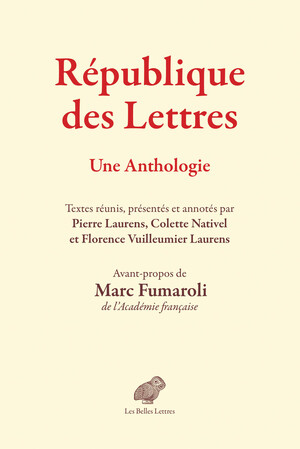
République des Lettres Une Anthologie (dir. Pierre Laurens, Colette Nativel, Florence Vuilleumier Laurens)
Posted: 29 Oct 2021 - 16:23

République des Lettres. Une Anthologie, dir. Pierre Laurens, Colette Nativel, Florence Vuilleumier Laurens, Préface de Marc Fumaroli, Paris, Les Belles Lettres, 2021.
Dans un cours sur ce thème au Collège de France, comme dans son maître-ouvrage, Marc Fumaroli a évoqué une notion largement inaperçue jusque-là, celle de la République des Lettres, restituant ainsi à l’Europe une de ses dimensions les plus incontestables.
Parti de ces réunions de savants, philologues, juristes, physiciens, naturalistes, tous des pairs, qui se reconnaissaient entre eux (cabinets, cénacles lettrés, académies), se choisissaient pour converser ou entamer un commerce de lettres dans un espace de liberté, il était remonté à l’origine : Pétrarque, créateur dans sa Correspondance d’une société de laïcs et de clercs qui partageaient sa vue d’une république chrétienne augmentée du meilleur de l’antiquité païenne, c’est-à-dire la civilisation, la capacité de sortir de la brutalité, la vertu des Humanités. Puis il avait suivi leur développement dans l’Europe des Lumières, jusqu’au moment où l’essor des nationalismes devait faire perdre le sens d’une communauté d’idées assez féconde pour qu’on en puisse nourrir la nostalgie.
Une enquête aussi vaste reposait sur l’analyse et le dépouillement d’une variété tant chronologique que thématique de textes de plus de cent auteurs dont la force et la beauté méritaient d’être partagées.
Offrir ces textes fut la tâche pour laquelle se portèrent volontaires trois amis proches de l’auteur. Le résultat est cette anthologie, qui donne à lire, dans le texte, la République des Lettres, depuis Richard de Bury et Pétrarque jusqu’à Leibniz et Mme du Châtelet.

Disponible en librairie et sur le site de l'éditeur.

Parution : 26/05/2021
CLIL : 3439
EAN13 : 9782251451886

Poétiques de la filiation Clément Marot et ses maîtres : Jean Marot, Jean Lemaire et Guillaume Cretin (Ellen DELVALLÉE)
Posted: 12 Oct 2021 - 04:15

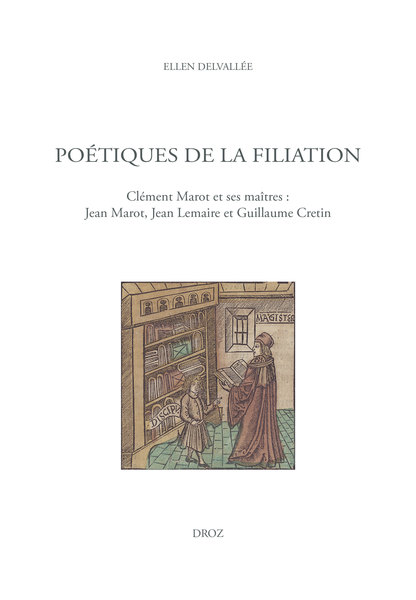
Ellen DELVALLÉE, Poétiques de la filiation Clément Marot et ses maîtres : Jean Marot, Jean Lemaire et Guillaume Cretin, Genève, Droz, 2021.

En étudiant l’esthétique de Clément Marot sous l’angle de sa dette envers trois Rhétoriqueurs de la génération précédente, ce livre remet en question l’idée d’une « révolution marotique », qui déterminerait, autour de 1530, en poésie française, la frontière entre Moyen Âge et Renaissance. Les deux premières parties, consacrées à la poésie épidictique de circonstance (déplorations funèbres et propagande historiographique), montrent comment les œuvres des trois Rhétoriqueurs sont en résonnance avec les changements qui affectent la culture et les devoirs attachés aux milieux de cour, changements qui annoncent et nourrissent les innovations de leur successeur. La dernière partie porte sur le témoignage que Marot donne lui-même de cette évolution, à travers des hommages réguliers aux trois maîtres, dans lesquels il manifeste sa dette ou s’en écarte, mais jamais de façon polémique. Par d’indéniables mutations des genres poétiques et par le récit personnel qui les met en évidence et leur prête parfois un sens rétrospectif, les poèmes de Marot construisent des scénarios et des poétiques de la filiation, qui se distinguent par la variété et la subtilité plutôt que par la rupture, qui caractérisera, à la génération suivante, la Pléiade.

Sommaire

Disponible en librairie et sur le site de l'éditeur.

Nombre de pages 976
Collection Travaux d'Humanisme et Renaissance
ISSN 0082-6081
Numéro DCXXII
Support Livre broché
ISBN-13 978-2-600-06263-3

"Early Modern Clouds" - Jeffrey N. Peters and Katharina N. Piechocki (eds)
Posted: 4 Oct 2021 - 12:26

Jeffrey N. Peters and Katharina N. Piechocki, eds., "Early Modern Clouds I." Romance Quarterly 68, 2 (2021) and "Early Modern Clouds II." Romance Quarterly 68, 3 (2021).
The essays in these two special issues reflect upon the multiform relations that hold between clouds and artistic production in early modern Europe. To what degree, we ask, do clouds embody a mode of depiction bound up with the expression of the ineffable? How do the constitutive tensions governing the evanescent shape of the clouds – e.g., they are at once absolutely devoid of being and fundamentally capable, as Aristophanes put it, of turning into anything at all – echo, derive from, and give form to the multiplicities of the poetic? More specifically, how do clouds acquire new meaning and generate new art forms when set to music or designed as operatic stage machines? How do the structuring qualities of clouds described by tradition as both masculine and feminine speak to and for the gendering of the poetic enterprise? How do the important developments in natural philosophy in the sixteenth and seventeenth centuries inform early modern understandings of clouds as an instance of physical and conceptual knowledge often derided as uncertain and speculative, and what effect did that derision have, if any, on the ways artists approached and learned from what we call the “poetics of meteorology”? 


Table of contents

Early Modern Clouds I

1. Jeffrey N. Peters and Katharina N. Piechocki, "Early Modern Clouds and the Poetics of Meteorology: An Introduction" (pp. 65-78)

2. Juliette Cherbuliez, "Jacques Callot's Billows, Puffs, and Plumes" (pp. 79-101)

3. Eugenio Refini, "Clouds as Synesthetic Metaphors Across Baroque Poetry and Music" (pp. 102-113)

4. Alison Calhoun, "What Cloud Machines Tell Us About Early Modern Emotions" (pp. 114-126)


Early Modern Clouds II


5. Vincent Barletta, "Clouds As Chaos Machines" (pp. 130-143)

6. Jeffrey N. Peters, "Clouds, Style, and Poetic Generation in Descartes's Météores (1637) (pp. 144-159)

7. Katharina N. Piechocki, "Clouds, Nuptials, Nubifications: At the Origins of Operatic Poetics" (pp. 160-176)

8. Mark Rosen, "Cartography and the Other Side of the Clouds" (pp. 177-195)


Early Modern Clouds I & II, available here (freely accessible for download from Taylor & Francis for the next several months:


https://www.tandfonline.com/toc/vroq20/68/2?nav=tocList

https://www.tandfonline.com/toc/vroq20/68/3?nav=tocList


Storytelling in Sixteenth-Century France: Negotiating Shifting Forms (Emily E. Thompson)
Posted: 2 Oct 2021 - 05:10

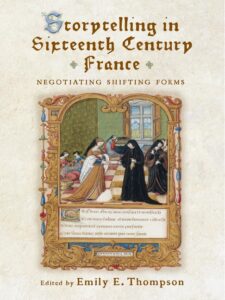
Emily E. Thompson, Storytelling in Sixteenth-Century France: Negotiating Shifting Forms, The University of Delaware Press, 2022.
Storytelling in Sixteenth-Century France is an innovative, interdisciplinary examination of parallels between the early modern era and the world in which we live today. Readers are invited to look to the past to see how then, as now, people turned to storytelling to integrate and adapt to rapid social change, to reinforce or restructure community, to sell new ideas, and to refashion the past. This collection explores different modalities of storytelling in sixteenth-century France and emphasizes shared techniques and themes rather than attempting to define narrow kinds of narrative categories. Through studies of storytelling in tapestries, stone, and music as well as distinct genres of historical, professional, and literary writing (addressing both erudite and more common readers), the contributors to this collection evoke a society in transition, wherein traditional techniques and materials were manipulated to express new realities.

Disponible en librairie et sur le site de l'éditeur.

Hardback : January 2022 • ISBN 9781644532379 • $120.00
Paperback : January 2022 • ISBN 9781644532362 • $46.95
* E-Book Available

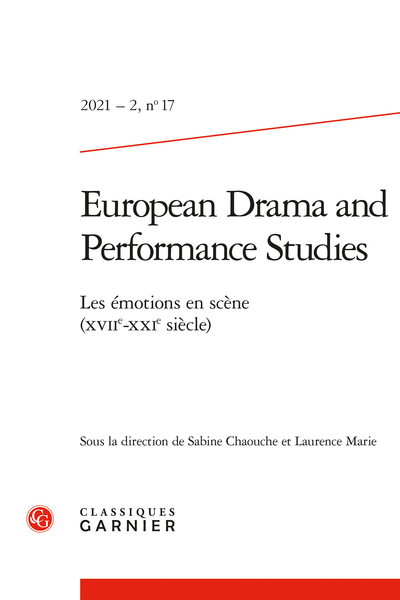
European Drama and Performance Studies 2021 – 2, n° 17 "Les émotions en scène (xviie-xxie siècle)"
Posted: 30 Sep 2021 - 08:37

European Drama and Performance Studies, 2, n° 17, 2021 : "Les émotions en scène (xviie-xxie siècle)", dir. Sabine Chaouche et Laurence Marie.

Disponible en librairie et sur le site de l'éditeur.

ISBN: 978-2-406-12206-7
ISSN: 2266-9035
DOI: 10.48611/isbn.978-2-406-12207-4
Éditeur: Classiques Garnier
Mise en ligne: 22/09/2021
Périodicité: Semestrielle
Langues: Français, Anglais