Announce

Calls for Papers and Contributions

CfP: "Many Will Travel": Translation and Travel in Early Cultures
Posted: Monday, July 31, 2017 - 15:01

The Center for Early Cultures at UC Irvine is pleased to announce our 2017 Conference – "Many Will Travel": Translation and Travel in Early Cultures.

Our keynote speakers will be Cynthia Brown from UCSB and John Ganim from UC Riverside.

Conference Date: October 13–14, 2017

Paper Proposal Deadline: August 31, 2017

Montaigne, in the early modern period, translates songs from the New World in his essay "On the Cannibals," even giving an account of the travel of several natives to Europe and suggesting provocatively the way their values might translate across to ours. From the ancient and medieval concept of translatio imperii studii to early modern relationships with the New World, early cultures provide us with an excellent set of ways for thinking about travel and translation.

This year's Early Cultures Conference is looking for papers that investigate how travel and/or translation figure into ancient, medieval, and early modern cultures. In addition to these political and cultural possibilities for travel and translation, we are also curious in the travel to imagined or poetic worlds. Also welcome are papers that consider travel to spiritual realms, where not all translation is strictly textual. In concord with these imaginative and religious travels, we also are interested in work that considers the modern need for translation of the past cultures that we are interested in. The move to "modernize" or "update" early texts like Shakespeare or Chaucer might suggests limits on our capacity to travel to the past. Indeed, we hope that in a conference where we continually travel to the past we will also shed light on the pressing problems regarding cultural, historical, and actual translation in the present. We invite papers that address this theme in history, literature, philosophy, or the history of art.

Possible Topics for Papers might Include:

  • Translatio imperii and the travel of empire
  • Travel narratives (and their translation)
  • Travel in romance
  • First contact and translation in the New World
  • Travel to ruins and sites of the ancient world
  • Translation and travel between historical periods
  • Travel and translation against hostile borders
  • The need to translate the past
  • Figuration and/or typology
  • The translation of ideas into new languages and/or disciplines

We invite abstracts of 300 words or less and a 1 page CV to be sent to early.cultures.conference@gmail.com by August 31, 2017.

Source: RSA

Call for contributions: Rewrite Conflicts: The Role of Losers, Heretics, and Outsiders in the History of Medicine
Posted: Monday, July 31, 2017 - 14:59

Invited editor: Fabrizio Baldassarri

Webpage: https://fbaldassarriphilo.wordpress.com/home/cfp-outcomes/

A multifaceted narration characterizes the contrapositions between schools, factions, theories, and practices in the history of medicine. Yet, studying these conflicts helps to shed light on those actors traditional historiographies usually relegate to secondary roles: surgeons, practitioners, apothecaries, botanists, astronomers, chymists, men and women devoted to the knowledge of simples. Especially when following losers, outsiders, heretics, and marginalized scholars, medical conflicts reveal epistemologically fruitful paths that help to track the changes buttressing early modern bio-medical revolution. While academic physicians required the support of theologians to rule out these practices as responsible for heresies, errors, and charlatanisms, kings frequently credited such outsiders as court physicians (i.e., Ambroise Paré, Guy de La Brosse), elevating their knowledge and experience to a crucial role. Slowly, these actors entered medical schools and academies, rewriting early modern history of medicine.

This fascicule aims to reconstruct this conflicting situation, and to analyse diverse cases of such outsiders and losers, moving from the sixteenth to the eighteenth centuries (wider focuses are accepted as well). Research articles coming from different fields (history of philosophy, psychology, science, medicine, botany, ideas, intellectual history, and history of life sciences…) are welcome.

Societate și Politică is a peer-reviewed scholarly journal published by Vasile Goldiș Western University of Arad, Romania. See http://uvvg.ro/socpol/.

Papers no longer than 8,000 words or book reviews no longer than 800 words should be submitted by email to fabrizio.baldassarri@gmail.com by 15 December 2017. Papers will go through a double-blind peer-review process. Publication is scheduled by 30 April 2018.

For the authors' guidelines see: http://socpol.uvvg.ro/index.php?option=com_content&view=article&id=48&Itemid=53.

CfP: Transition(s): concept, methods and case studies (14th–17th centuries): PhD students
Posted: Monday, July 31, 2017 - 14:57

International PhD Students' Meetings

PART 1 “Transition(s): concept, methods and case studies (14th–17th centuries)” Liège, 30th and 31st January 2018

http://web.philo.ulg.ac.be/transitions/fr/

The Research Unit Transitions. Middle Ages and First Modernity (University of Liège) associated with the research laboratory TRAME (Texts, Representations, Archaeology and Memory from Antiquity to the Renaissance) of the University of Picardie Jules Verne and with the Centre for Advanced Studies in the Renaissance of the University François Rabelais (Tours) on the occasion of International PhD Students' Meetings in three parts. Implemented by PhD students of these three institutions, the aim of the meetings is to enable exchange and discussion between PhD students, junior researchers and skilled colleagues. The first of these three meetings will be held in Liège on Tuesday January 30th and Wednesday January 31st, 2018.

From the Middle Ages until the upheavals brought about by Galilean science, Europe underwent a period of unceasing questioning which challenged the political balance and its legitimacy, shook the foundations of confessional unity, and expanded the limits of knowledge and of creation. In an attempt to transcend the inherited divisions of the long historiographical tradition, the Research Unit Transitions. Middle Ages and First Modernity (http://web.philo.ulg.ac.be/transitions/fr/) explores these constant transformations in the Western and in the Mediterranean Basin. Open to Medievalists and Modernists, the Research Unit promotes confrontation between research practices, original collaboration, and the sharing of results in a transdisciplinary way. Furthermore, it attempts to show several factors which contributed to the construction of the social and cultural frameworks by which we define ourselves even today.

In January 2018, the Liège meetings will focus on the theme “Transition(s): concept, methods and case studies (14th–17th centuries)”. Nowadays, the Social Sciences and Humanities Research on the whole tend to delete categories and traditional historical periodization in favor of transversal approach of objects, phenomena, genders, forms and ideas. The concept of “Transition” is linked to the idea of “passage” and it may be defined as “the passage from one state to another” a “degree or an intermediate state” (Trésor de la langue française). From their own research objects, participants will be asked to think on this concept, its acceptability and its relevance toward those of “Mutation”, “Change”, “Transformation”, “Modification”, “Revolution” and “Metamorphosis”. Thereby, it aims to renew the debate on the methods and theoretical ways which mark all disciplinary fields presented in those meetings.

How does one develop a methodology and an analytic grid allowing the study of objects, practices and behaviours positioned between two elements, between two historical periods, between two trends, between two styles, between two manners to do, to see, to write, to think and to believe? Also, how does one get out of this idea of “between two”? Do Transition have breaks, innovations, transfers, exchanges or flow aspects? Do these objects really depict the passage from a practice, a period, from one style to another, or is it actually because the Researcher sees them as doing so? Is the concept of “Transition” a new category, a new pragmatic approach, but nevertheless fruitful? Is this concept involved in advances in our disciplines, and why?

This methodological approach may be considered by concrete questions about the linguistic, cultural, historical, artistic transitions which happened between the 14th and the 17th centuries in Western Europe and the Mediterranean basin, whether through actors and their works (objects, texts), ideas, and / or the areas within which they lived.

Lectures will be the subject of transdisciplinary discussions. They should not last more twenty minutes and they will be given in either French, English or Italian. Each lecture will then be followed by a short debate with the audience.

The organising committee espects the PhD students' proposals for Friday the 15th of September 2017 at the latest. They should be addressed to the RU Transitions (journeesdoctorales.transitions@gmail.com) as an attached document that includes the personal data of the PhD student and those of the research director(s), as well as the title of the thesis, the title of the lecture, the year of registration as a PhD student and, finally, a fifteen-line summary of the proposed lecture. Proposals are to be written in French, English or Italian. Candidates will be informed of the approval or the rejection of their proposal by the 15th of October 2017.

Each PhD student is invited to contact his own institution about the possibility of valorising his or her participation in the study days within the framework of their doctoral training (attestation, ECTS credits, etc.). At the end of the seminar, the organizers will provide a document certifying the active participation of the PhD student in the meeting. Furthermore, in view of its limited financial resources, RU Transitions will not be able to bear the cost of mobility and accommodation for Participants.

Organising Committee : Emilie Corswarem, Sébastien Damoiseaux, Frédéric Degroote, Aurore Drécourt, Adelaïde Lambert, Anne-Sophie Laruelle, Julie Piront

Scientific Committee : Emilie Corswarem, Annick Delfosse, Laure Fagnart, Marie-Elisabeth Henneau, Nicola Morato, Julie Piront


CFP: Eighth Annual RefoRC Conference 2018
Posted: Monday, July 31, 2017 - 14:55

The Eighth Annual RefoRC Conference is hosted by the University of Warsaw and will take place May 24–26, 2018

Theme of plenary lectures: Reformation and Education

The Reformation was closely tied to the renovation of educational models from its very beginning. By questioning the model of the medieval university and establishing new pedagogical solutions, early modern scholars and teachers shaped subsequent generations of clergy and laity, enabling them to work for their local communities and engage in the public sphere. Often these educational agendas went well beyond changes in curricula and were oriented towards much deeper goals, such as the shaping of confessional identity or the achieving of universal religious peace through the advancement of learning.

As one of the leading research and educational institutions in Poland and East-Central Europe, the University of Warsaw is the perfect venue to ask further questions about the complex relations between early modern religious and pedagogical reforms. The plenary papers will offer a multi-faceted approach to this topic and will be accompanied by a series of short papers discussing all kinds of subjects related to the history of the Reformation. The aim of the conference is thus to broaden and contextualize the intersections between religious and educational reform.

Short Papers, Panels, and General Attendance The conference is open to individual short paper presentations (20-minute presentations) and to thematic sessions of two or three short papers. While we encourage papers on the conference theme, papers can also focus on all disciplines related to the sixteenth-century Reformations, such as philosophy, law, history, theology, etc., independent of the theme of the plenary papers. Short paper proposals are welcome before March 1, 2018.

Language The language of the conference is English, but papers in French and German will be welcomed.

https://www.reforc.com/eighth-annual-reforc-conference-2018warsaw/

Source: RSA

Call for contributions: Journal of History of Ideas
Posted: Monday, July 31, 2017 - 14:45

It is a great pleasure to announce that the direction of the Journal of History of Ideas decided to devote its 2018 issue to the subject:  "Religions and Cultures".

Proposals for articles should strictly follow the «Guidelines for Authors» published on our website [ http://www.uc.pt/en/fluc/ihti ] and may be submitted until 30 September 2017.

I would be grateful if you forward this call for papers to other researchers who would like to submit articles (in Portuguese, English, French, Spanish and Italian) in the next Journal of History of Ideas.

Thank you very much for your cooperation.

Best regards,

Ana Cristina Araújo

Professora Associada com Agregação

Diretora da Revista de História das Ideias

DHEEAA - Faculdade de Letras Universidade de Coimbra Largo da Porta Férrea 3004-530 COIMBRA-PORTUGAL tel: 00.351. 239 859930/Ext. 4292


New Publications

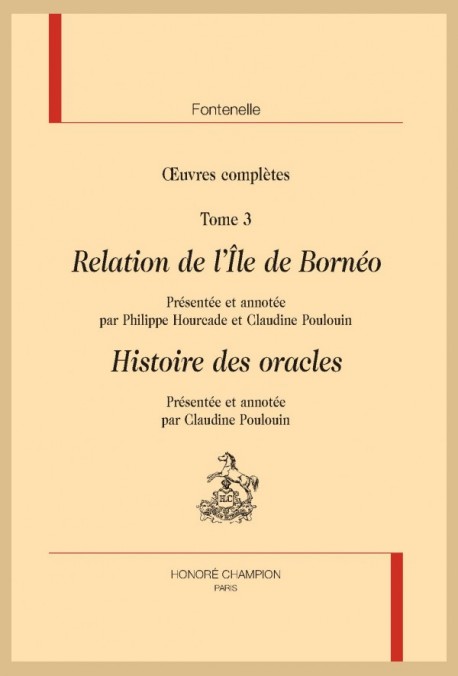
Fontenelle, Oeuvres complètes, t. 3 (éd. Claudine Poulouin et Philippe Hourcade)
Posted: 16 Sep 2021 - 10:07

Fontenelle, Oeuvres complètes, t. 3, éd. Claudine Poulouin et Philippe Hourcade, Paris, H. Champion, 2021.
L’Extrait d’une Lettre écrite de Batavia (plus tard connu comme Relation de l’Île de Bornéo), publié dans les Nouvelles de la République des Lettres de janvier 1686, et l’Histoire des oracles, publiée sans nom d’auteur à la fin de la même année, sont sans doute les textes les plus audacieux que Fontenelle ait osé publier. Il est toujours dangereux de s’en prendre aux autorités théologiques et politiques, surtout lorsqu’elles se confondent. C’était le cas dans le temps de la révocation de l’Édit de Nantes. La prudence de Bayle présentant l’Extrait comme issu de la plume du « galant auteur » des Nouveaux dialogues des morts qui ne s’intéressait plus désormais qu’aux mathématiques, l’ironie de Voltaire présentant l’Histoire des oracles comme un simple abrégé élégant du traité de Van Dale ont pu brouiller leur portée corrosive. Mais on sait que rien n’est si sérieux chez Fontenelle que la plaisanterie et l’apparente légèreté de ton. La plaisanterie telle que la pratique Fontenelle est, sous couvert de divertissement, un moyen de réflexion et de connaissance. C’est une façon de penser pour faire tomber les murs de l’inhibition et du respect forcé. Dans l’un et l’autre de ces deux textes, Fontenelle met au jour les manœuvres intellectuelles qui faussent les choses et favorisent une soumission aveugle à la domination des discours d’autorité. Il y invite le lecteur à laisser la raison jouer son rôle en faveur d’une liberté de pensée qui ouvre sur l’une des formes les plus ambitieuses de l’esprit des Lumières.

Disponible en librairie et sur le site de l'éditeur.

Nombre de pages: 284
Date de publication : 23/08/2021
ISBN9782745355805

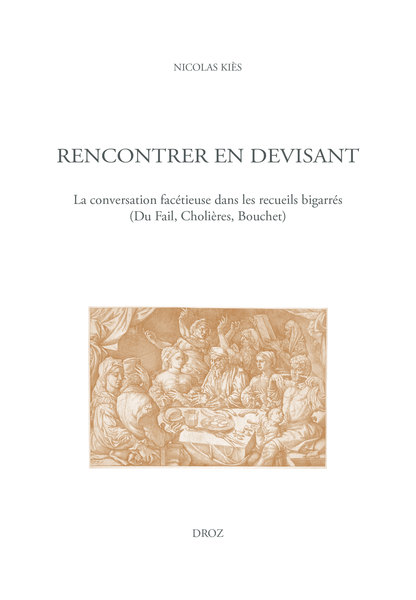
Rencontrer en devisant La conversation facétieuse dans les recueils bigarrés (Du Fail, Cholières, Bouchet) (Nicolas KIÈS)
Posted: 14 Sep 2021 - 08:09

Nicolas KIÈS, Rencontrer en devisant La conversation facétieuse dans les recueils bigarrés (Du Fail, Cholières, Bouchet), Genève, Droz, 2021.
Autour de 1585 paraissent en France des recueils dialogués cultivant l’hybridité formelle et le mélange des tons : Contes et discours d’Eutrapel de Noël du Fail, Matinées et Apresdisnées de Cholières, Serées du libraire-imprimeur Guillaume Bouchet. Ces ouvrages bigarrés mettent en scène d’étonnantes conversations aussi plaisantes qu’érudites. Première étude d’ampleur sur le sujet, le livre de Nicolas Kiès interroge la poétique de ces textes mêlés à travers les notions de « facétie » et de « devis », situées au carrefour de l’histoire des formes et de la sociabilité. Alors que le Royaume est toujours en proie aux guerres civiles, ces conversations facétieuses ébauchent des modèles de coexistence originaux, valorisant la liberté de parole, les conflits ludiques et les ententes paradoxales. En cette fin de Renaissance s’esquisse un tournant important de l’histoire de la conversation, entre urbanité et rusticité, politesse et gauloiserie.

Disponible en librairie et sur le site de l'éditeur.

Année de publication 2021
Nombre de pages 504
Collection Travaux d'Humanisme et Renaissance
ISSN 0082-6081
Numéro DCXXIV

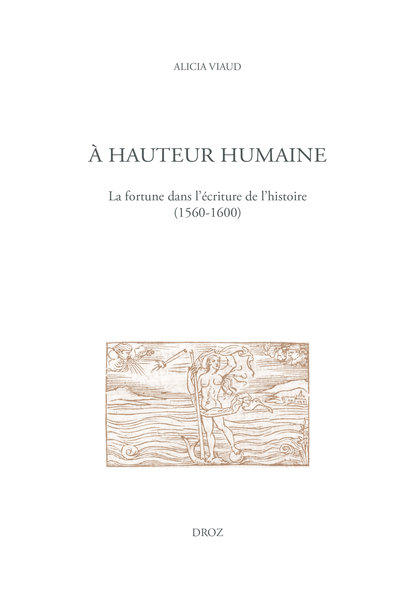
À hauteur humaine La fortune dans l'écriture de l'histoire (1560-1600) (Alicia Viaud)
Posted: 14 Sep 2021 - 08:05

Alicia Viaud, À hauteur humaine. La fortune dans l'écriture de l'histoire (1560-1600), Genève, Droz, 2021.
Dans les dernières décennies du xvie siècle, s’épanouit une histoire « à hauteur humaine », par l’objet qu’elle se donne – l’ensemble de ce qui est relatif aux femmes et aux hommes du passé – et par les limites qu’elle se fixe – les capacités humaines d’intelligence du monde. La fortune, à la fois lieu commun et objet polémique, contribue au développement de cette pratique d’écriture qui se veut séculière, quoiqu’elle prenne toujours en considération la volonté divine. Dans les livres d’historiens comme dans les Mémoires, toujours niée mais fréquemment mentionnée, elle est un outil contribuant à établir les structures logiques et temporelles des récits, leurs stratégies argumentatives, leur valeur édifiante ou pratique. Elle permet de penser l’adversité comme obstacle et comme limite aux entreprises humaines, de concevoir l’action entre calcul raisonnable et pari audacieux, ainsi que de s’approprier le passé, en conférant aux histoires singulières des caractéristiques communes.

Disponible en librairie et sur le site de l'éditeur.

Année de publication 2021
Nombre de pages 664
Collection Travaux d'Humanisme et Renaissance
ISSN 0082-6081
Numéro DCXXV


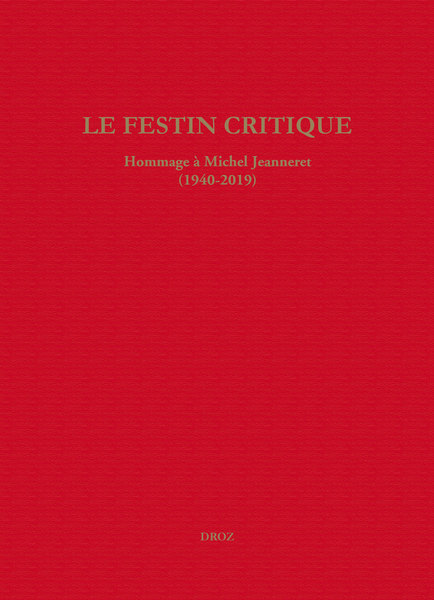
Le Festin critique Hommage à Michel Jeanneret (1940-2019) (dir. Frédéric TINGUELY, avec Jérôme DAVID et Radu SUCIU)
Posted: 14 Sep 2021 - 08:02

Le Festin critique Hommage à Michel Jeanneret (1940-2019), dir.  Frédéric TINGUELY, avec Jérôme DAVID et Radu SUCIU, Genève, Droz, 2021.
Michel Jeanneret (1940-2019) fut sans conteste l’un des grands critiques de sa génération, l’un des commentateurs les plus inspirants de la littérature et de la culture des XVIe et XVIIe siècles. Des paraphrases de psaumes aux provocations des bouffons et des libertins, des propos de table à la fascination des métamorphoses et des forces chtoniennes, des ambiguïtés rabelaisiennes à la folie nervalienne, son œuvre n’a cessé d’interroger – sous mille aspects divers mais dans la cohérence d’un style –, le clair-obscur de notre pré-modernité et de ses prolongements. Pour rendre hommage à cette figure importante de l’École de Genève, il fallait un Festin critique au menu pantagruélique : on y trouvera tout d’abord deux conférences inédites prononcées par M. Jeanneret en 2018 et réunies sous le titre « Le moment de Protée (1550-1630) », puis neuf textes sur les principaux aspects de sa trajectoire critique signés par les meilleures et les meilleurs spécialistes (C. Ossola, M. Engammare, F. Lestringant, T. Cave, F. Lecercle, F. Lavocat, J.-P. van Elslande, D. Brancher et J. David), enfin une trentaine de témoignages plus personnels placés sous le signe de la gratitude et de l’amitié. Le tout agrémenté d’une riche iconographie en couleurs et complété de la bibliographie des travaux de M. Jeanneret.

Disponible en librairie et sur le site de l'éditeur.

Année de publication 2021
Nombre de pages 280
Collection Travaux d'Humanisme et Renaissance
ISSN 0082-6081
Numéro DCXXIII

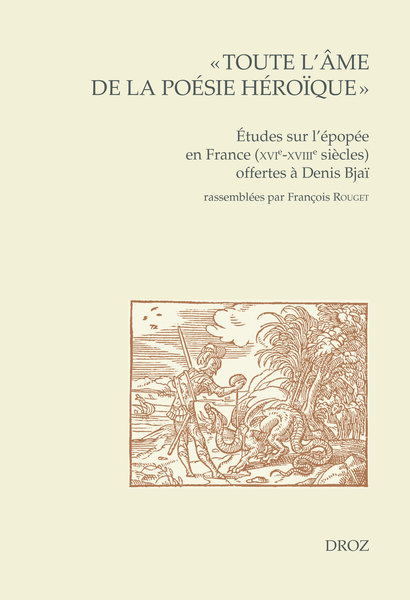
« Toute l'âme de la poésie héroïque » Études sur l'épopée en France (XVIe-XVIIe siècles) offertes à Denis Bjaï (dir. François Rouget)
Posted: 14 Sep 2021 - 07:58

« Toute l'âme de la poésie héroïque » Études sur l'épopée en France (XVIe-XVIIe siècles) offertes à Denis Bjaï, dir. François Rouget, Genève, Droz, 2021.

En 2017, Denis Bjaï a pris sa retraite d’enseignant-chercheur à l’Université d’Orléans où il a passé l’essentiel de sa carrière. À l’occasion de son départ, ses collègues universitaires, de France et de l’étranger, ont souhaité se réunir pour constituer un ensemble d’études qui forment ses « Mélanges ». Centrées autour de la notion d’épopée et des formes du discours héroïque, les quinze études qu’on découvrira ici s’attachent à rappeler le rôle important que jouent le discours, les thèmes et le style épiques dans la littérature française du Moyen Âge jusqu’au XVIIIe siècle. Si Ronsard, avec La Franciade, occupe la place centrale de ce volume, d’autres écrivains (d’Homère à Fénelon, en passant par Bodel, Rabelais, Du Bartas, D’Aubigné et La Fontaine) laissent percevoir dans leurs œuvres l’étoffe variée dont l’épopée est faite, et font entendre les composantes de sa rhapsodie.

Disponible en librairie et sur le site de l'éditeur.

Nombre de pages 320
Collection Cahiers d'Humanisme et Renaissance
ISSN 1422-5581