
Announce

Calls for Papers and Contributions

CfP: Gendered Environments
Posted: Tuesday, February 26, 2019 - 10:42

Baltimore (21-23 mai 2020), avant le 17 mars 2019

2020 Berkshire Conference on the History of Women, Genders, and Sexualities

Baltimore, Maryland

Deadline: Sunday, March 17, 2019

Gendered Environments: Exploring Histories of Women, Genders, and Sexualities in Social, Political and “Natural” Worlds

Program Chairs: Cathleen Cahill (Penn State) and Martha Few (Penn State)

Call for Papers: the 18th Berkshire Conference on the History of Women, Genders, and Sexualities May 21-23, 2020 at Johns Hopkins University in Baltimore, Maryland. (Download 2020 CFP)

The theme for the 2020 Berkshire Conference on the History of Women, Genders, and Sexualities will be Gendered Environments: Exploring Histories of Women, Genders, and Sexualities in Social, Political, and “Natural” Worlds. The conference will be held May 21-23, 2020 at Johns Hopkins University in Baltimore, Maryland.

The 2020 “Big Berks” focuses on the histories of women, genders, and sexualities, and this year devotes special attention to a pressing theme of our current moment: the role of environment(s), ecologies, and natural systems broadly defined in the histories of women, genders, and sexualities. As we plan our meeting at the edge of the Chesapeake Bay, a profoundly vibrant ecosystem where humans have gathered for millennia, we are reminded of the many ways in which the natural world has shaped human society. Its history also highlights the local and global connections of all places. This place is the homeland of the Piscataway Conoy Tribe, and was home to Henrietta Lacks; it is the site of the Baltimore Fish market and a part of the Chesapeake Bay Watershed, a node in the Atlantic Flyway, and at the edge of the Atlantic World.

Our aim is to hold conversations that think through the intricate interplays among gender and sexuality, social and legal systems of power and political representation, and the material realities of an interconnected world continually shaped by physical nature, the human and nonhuman animals, plants, and other beings that inhabit that nature. If Earth’s history has indeed entered a new geological epoch termed the Anthropocene, where do the historical knowledges and experiences of women, people of diverse genders and sexualities, and people of color, along with environmental justice efforts in the historical past, enter into our efforts to understand, theorize, contextualize, and meet these existential problems?

While the notion of environments invokes important thinking about Earth, our theme extends to a capacious definition of social, cultural, and political surrounds. The histories of women’s lives, intellectualism, and activism unfold across a range of environmental contexts that are simultaneously material, political, economic, and cultural. We interpret this overarching theme broadly, inviting submissions for an array of engaging and interactive presentations intended to generate conversations across time, fields, methodologies, and geographic borders; across races, classes, sexualities and gender  identities; among academic and public historians, activists, artists and performers. We are especially keen to attract participants from around the globe and scholars of time periods and geographic fields that typically have been underrepresented at the Berkshire Conference.

We hope these conversations will highlight fresh perspectives and create new networks for intellectual collaboration and activism among scholars, public historians, artists, activists, teachers, and those interested in history, the environment, climate change, social movements, and social justice. Such interaction has dynamic potential to move the history of women, genders, and sexualities in particularly innovative directions that generate new theories and methodologies, bringing these histories into new spaces – not only in our universities and liberal arts colleges but also in community colleges, neighborhood centers, K-12 schools, prisons, NGOs and other activist groups in the United States and abroad. Such an approach is critical as we are experiencing the effects of pressing environmental issues, even as the value of research from climate science to the humanities is being questioned.

Reviving connections between communities and institutions, historians are increasingly joining forces — inside and outside the academy – with an eye toward affecting social change and social justice. New forms of cooperation have raised important historical questions: What can we learn from internationalizing the discussion of women, communities, and the environment? How can we use multi-sited histories of human and non-human animals as well as the relationships of communities to local and distant ecologies to rewrite gendered histories from long distance trade and exchange to the rise of global capitalism? How can scholars and activists collaborate to transform the pedagogical landscape in our ‘classrooms’ around environmental issues in the past and present? This conference is a call for collaboration and cooperation across many lines of difference.

The 2020 Berkshire Conference will be a venue for difficult conversations about these and other crucial questions. In the hope of promoting a greater range of conversations and interactions, this “Big Berks” seeks to intentionally diversify the way we present and discuss history. In addition to traditional modes of presentation, we encourage the submission of conference presentations that feature different kinds of voices. We strongly encourage submissions that include scholars, public historians and/or activists, artists, and/or performers. We also encourage submissions that include multiple styles — such as digital technologies, formal papers, performance, and/or the arts — along with varied formats from e-posters, pop-up talks to lightning sessions.

We invite submissions broadly themed on the histories of women, genders, and sexualities, including but not limited to those with a special interest in environment(s), ecologies, and natural systems.

The deadline for all submissions is March 17, 2019.
CfP: Women and Gender in the Premodern Mediterranean
Posted: Tuesday, February 26, 2019 - 10:40

Baltimore (21-23 May 2020), proposals due 10 March 2019

18th Berkshire Conference on the History of Women, Genders & Sexuality


The Mediterranean has been acknowledged as a distinct environment since at least the work of Fernand Braudel, yet despite this fact, many of the broader studies on the Mediterranean have paid little attention to women and gender. This is particularly the case for studies of the premodern past. For next year’s conference in Baltimore, Berks organizers have invited us to think about gendered environments « through the intricate interplays among gender and sexuality, social and legal systems of power and political representation, and the material realities of an interconnected world continually shaped by physical nature, the human and nonhuman animals, plants, and other beings that inhabit that nature. » With that in mind, we are planning a workshop to explore the Mediterranean as a gendered environment.

We invite proposals from scholars whose work considers the above themes in relation to any location in the Mediterranean in the medieval and early modern periods. Our workshop aims to facilitate a comparative discussion on women from different social, religious, and geographical contexts of the Mediterranean world. In particular, we would like to bring together scholars whose work focuses on Christian, Jewish, or Muslim women, across social hierarchies, and geographical locations. If you are interested, send a 250-word abstract and contact information to Alexandra Guerson (alexandra.guerson@utoronto.ca) and Dana Wessell Lightfoot (lightfoot@unbc.ca ) by March 10th, 2019.

CfP: RACINE’S BRITANNICUS
Posted: Tuesday, February 19, 2019 - 13:45

A one-day symposium to mark the 350th anniversary of the first performance.

Proposals are invited for papers of 20 to 30 minutes on any aspect of the play and its cultural contexts.  Contributions may be in English or French.  Participants who wish to attend but do not wish to offer a paper are warmly welcome, but should book their places as accommodation is limited.

Date: Friday 6 September 2019, from 11 a.m. to 5 p.m.

Venue:The British Academy, 10-11 Carlton House Terrace, London

Cost: £30, including a buffet lunch.

Proposals for papers, and indications of a wish to attend by those not offering papers, should be sent to Professor Paul Hammond, School of English, University of Leeds, LS2 9JT (p.f.hammond@leeds.ac.uk) by 1 April 2019.

CfP: Motion, Rhythm, Shifts
Posted: Monday, February 18, 2019 - 13:03

An interdisciplinary conference. 5 October 2019. Rhode Island School of Design

In 2019, the New England Renaissance Conference will be hosted for the first time at the Rhode Island School of Design (RISD, pronounced “RIZ-dee”), a private, nonprofit college founded in Providence in 1877, which has currently circa 2,400 students from around the world. RISD offers liberal arts studies and 19 studio majors in the fine arts, architecture, design or art education (bachelor’s or master’s degrees).

We invite papers that explore the notion of rhythm in the period of ca. 1400-1700. Scholars from disciplines as varied as history, art history, literature and poetry, religion, theatre, music, environment, studio art and design are welcomed. The idea of motion, rhythm, and shifts is rich in significance for the Early Modern period as it touches upon global concepts, material culture, ritual, performance, and identity.

Paper topics include, but are not limited to:

  • temporal aspects (codification of time, recurrence of a specific phenomenon, the timing of a performance, stages in the production of art, series, metamorphoses)
  • movements and crossings (body movements, dance, inter-arts, transportation / re-location of people, things, images, or relics)
  • mobilities (migrations, trade patterns, traveling artists, scansion of narratives or poetry, translations)
  • ritual and ceremonies (processions, parades, ceremonial entries, relics transfers, etc.)

DATE: Saturday 5th October 2019, 9:00 a.m. – 6:00 p.m.

LOCATION: Chace Auditorium, Rhode Island School of Design Museum, Providence

The conference will be free to all. A dinner and accommodation on 4th October are planned for the speakers.

We invite abstracts no longer than 300 words accompanied by a title and a brief CV to be sent by May 1, 2019, to:   prihouet@risd.edu. For further questions, feel free to contact conference organizer Prof. Pascale Rihouet at that email address.

See also: http://www.new-england-renaissance-conference.org/

Source: H-France

CfP: Women in French at PAMLA
Posted: Friday, February 15, 2019 - 13:57

Wyndham Bayside in San Diego, California from Nov. 14-17, 2019(https://pamla.org/2019).


Please send proposed title, abstract (250-300 words), and contact information to: youna.kwak@pomona.edu(specifying which panel you are interested in) by the deadline of April 1, 2019.


If you have any questions, don’t hesitate to contact either me or the panel chair directly.


 Women’s Infidelity

Chair: Francis Mathieu, Southwestern University (mathieuf@southwestern.edu)


This bilingual panel proposes to examine how French and francophone women authors have dealt with the somewhat taboo or understated topic of women’s infidelity in their writings, both in contemporary literature and in past centuries. Whereas infidelity was once regarded as a male problem or the purview of rich, powerful men, this cliché has never really matched reality. Yet, before the advent of contraception, cheating was much riskier for women, and the consequences could be severe, and can still be perilous in some societies. Birth control, women’s liberation, and push up against prescribed gender norms have been a recipe for change. How have French and francophone women authors addressed these situations and other related issues and elements in their works? Papers may be in English or in French.


Women’s Agency in Wartime

Chair: Anne Donadey, San Diego State University (adonadey@sdsu.edu)


Literary and film representations of women in wartime as combatants or peace agents; texts with a focus on women’s agency in wartime. Does genre or the gender of writers/filmmakers make a difference in representations of women?


Most war literature and film showcases male characters, their conflicts—external and inner—and their agency. A number of feminist scholars have demonstrated that men are generally seen as having a metonymic relation to the nation as its active protectors. In contrast, women are perceived as having a metaphoric relation to the nation as the passive group in need of protection. As a result of this ideological configuration, women are seen as less than full citizens and their rights within a nation must constantly be struggled for (Elleke Boemer 1991; Mrinalini Sinha 2004). This panel will focus on French and Francophone literature and film from any period that offers representations of women’s agency in wartime, as combatants, peacemakers, or in other important roles. What formal techniques are used to showcase women’s agency? What appear to be the political purposes of focusing on women’s agency? Does genre or the gender of writers/filmmakers play a part in representations of women with agency in wartime? Papers in English or French welcome.

New Publications

Soigner l’humain Péchés et remèdes chez Montaigne et Descartes (Jil Muller)
Posted: 15 Jun 2022 - 04:42

Jil Muller, Soigner l’humain Péchés et remèdes chez Montaigne et Descartes, Paris, Classiques Garnier, 2022.

À partir d’une étude comparatiste, ce livre analyse les pensées de Montaigne et de Descartes sur le péché, en suivant un schéma à la fois clinique et thérapeutique. Ainsi se dévoile le début d’un processus de sécularisation au cours duquel la religion chrétienne est réintégrée dans une nouvelle pensée morale.

Nombre de pages: 501

Parution: 18/05/2022

Collection: Essais philosophiques sur Montaigne et son temps, n° 10

ISBN: 978-2-406-13027-7

ISSN: 2116-7974

Disponible en librairie et sur le site de l'éditeur.

L'Enfant rêvé. Anthologie des théâtres d’éducation du xviiie siècle
Posted: 15 Jun 2022 - 04:37

L'Enfant rêvé. Anthologie des théâtres d’éducation du xviiie siècle

Plagnol-Diéval (Marie-Emmanuelle), Brucker (Nicolas), Ehl (Patricia), Ponzetto (Valentina), Simonin (Charlotte), Audy-Trottier (Andréane), Boulerie (Florence), Chiron (Jeanne)
Directrice d'ensemble: Plagnol-Diéval (Marie-Emmanuelle)

Résumé: L’Enfant rêvé, anthologie de pièces de théâtre destinées à la jeunesse composées et jouées durant le xviiie siècle, éclaire la révolution qui s’opère autour de la figure enfantine et adolescente, ses relations avec le monde, ses apprentissages dans un siècle passionné par la pédagogie.

Nombre de pages: 1856
Parution: 25/05/2022
ISBN: 978-2-406-12228-9
ISSN: 2109-7577

Disponible en librairie et sur le site de l'éditeur.

Senancour Penser nature (Yvon Le Scanff)
Posted: 15 Jun 2022 - 04:35

Yvon Le Scanff, Senancour. Penser nature, Paris, Classiques Garnier, 2022.

Cet ouvrage présente Senancour comme un penseur qui place la force immanente et universelle de la nature au cœur d’une intuition fondamentale et programmatique, mais également comme un écrivain qui invite la pensée à se faire littéraire et la littérature à se mettre à l’épreuve des idées.

Nombre de pages: 377

Parution: 25/05/2022

Collection: Études romantiques et dix-neuviémistes, n° 116

ISBN: 978-2-406-13004-8

ISSN: 2103-4672

Disponible en librairie et sur le site de l'éditeur.

La Lettre clandestine n° 30 2022 Émilie Du Châtelet et la littérature philosophique clandestine
Posted: 15 Jun 2022 - 04:32

La Lettre clandestine, n° 30
2022 "Émilie Du Châtelet et la littérature philosophique clandestine"

Directeurs d'ouvrage: Moreau (Pierre-François), Seguin (Maria Susana)

Résumé: La Lettre clandestine réunit des recherches sur les manuscrits philosophiques clandestins des xviie et xviiie siècles qui ont fourni aux philosophes des Lumières une grande partie de leurs idées et de leur culture.

Nombre de pages: 358
Parution: 25/05/2022
ISBN: 978-2-406-13257-8
ISSN: 1242-3912

Disponible en librairie et sur le site de l'éditeur.

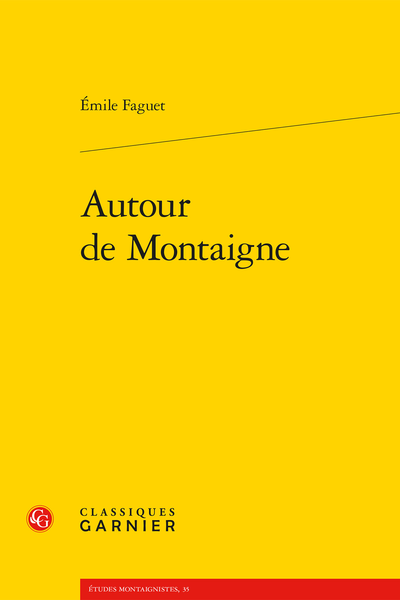
Études sur Montaigne (1898-1907) (Ferdinand Brunetière)
Posted: 15 Jun 2022 - 04:28

Ferdinand Brunetière, Études sur Montaigne (1898-1907), préface Antoine Compagnon, Paris, Classiques Garnier, (1999) 2022.

Dès ses cours à l'École normale dans les années 1880, Ferdinand Brunetière pose les fondements du principe philologique et du principe pédagogique qui ont réglé la lecture des Essais tout au long du xxe siècle et ont induit le désaveu de l'édition de 1595, préparée par Marie de Gournay.

Nombre de pages: 157

Parution: 25/05/2022

Réimpression de l’édition de: 1999

Collection: Études montaignistes, n° 34

ISBN: 978-2-406-13197-7

ISSN: 0986-492X

Disponible en librairie et sur le site de l'éditeur.