



Announce

Calls for Papers and Contributions

Appel à contributions: Emotions de l’Ancien Régime (XVIIème-XVIIIème siècles)
Posted: Friday, March 24, 2017 - 17:33

Le Monde français du XVIIIe siècle

Eighteenth Century French World Group

http://ir.lib.uwo.ca/mfds-ecfw/

Emotions de l’Ancien Régime

(XVIIème-XVIIIème siècles)


L’un des tropes contemporains sur l’émotion est la relation, dévoilée par les

neurosciences, entre ces deux domaines qu’on croyait distincts, la cognition et les

affects. Selon António Damàsio, cette relation mise à jour constituerait signerait

définitivement « l’erreur de Descartes » (1995).


A chaque époque, son savoir sur les émotions, mais aussi « son » émotion : sa

sensibilité, ou même une image singulière qui lui appartient en propre ou que la

postérité a figée. Le double ouvrage collectif Histoire des émotions, dirigé par Alain

Corbin, Jean-Jacques Courtine et Georges Vigarello (2016), saisit depuis l’Antiquité

jusqu’à la fin du XIXe siècle les expressions de l’âme qui disent quelque chose de leur

temps, des larmes d’Achille de l’Antiquité jusqu’à la théorie des humeurs, passant par

l’extase médiévale et la colère des princes.


Si les emotion studies sont en plein essor dans les études littéraires, en esthétique et

en histoire (voire Bouju et Gefen 2012, Vernay 2013, le projet multidisciplinaire

australien « The History of Emotions 1100-1800 », ou encore la série d’émissions de

France Culture consacrée aux émotions en 2016), l’on peut cependant penser au

champ disciplinaire tantôt délaissé et faisant tantôt retour qu’est la rhétorique : Gisèle

Mathieu-Castellani (2000) rappelle à ce titre que l’oratio latine est avant tout une

« entreprise de séduction » avant de s’adresser à la raison (le domaine du sermo) de

l’auditoire.


La différence actuelle des récents travaux concerne tout d’abord l’aspect volontiers

transversal de l’entreprise de recherche sur les émotions, alliant analyse du discours et

interaction entre l’esthétique et le privé, qui peut éventuellement situer l’émotion dans

une perspective de genre, de milieu ou de race ; d’autre part le dévoilement d’objets

oubliés, de tableaux énigmatiques, de lettres et de discours mineurs qui révèlent les

mouvements de l’âme de leurs producteurs, récepteurs ou commentateurs. Enfin, la

littérature, en particulier, aurait vocation à nous enseigner un savoir sur les émotions

(voire Patrick Colm Hogan 2011).


En vue de la parution prévue du nouveau volume de la revue électronique Le monde

français du XVIIIe siècle, nous accueillons diverses contributions de la part des

chercheurs et doctorants qui travaillent sur le XVIIe et/ou le XVIIIe siècle, aussi bien en

littérature, en histoire, en histoire de l’art ou des idées.


Au XVIIe siècle, les premiers dictionnaires révèlent la difficulté taxonomique du terme

« émotion ». Pour Pierre Richelet (1680), l’émotion est un « trouble », une « sédition »

ou un « tremblement » qui excite l’agent. Antoine Furetière omet le substantif de son

Dictionnaire universel (1690) tandis que le Dictionnaire de l’Académie française (1694)

décrit que l’émotion est une « altération, mouvement […] dans les esprits ». L’on passe

de la turbulence sociale et politique qui marque le règne d’Henri IV à l’époque de la

raison où l’émotion est plus restreinte, plus intériorisée quoique toujours sociale.

Du rire aux larmes, les auteurs du Grand Siècle mettent en lumière la relation entre

l’émotion et le public, le comportement et sa réception. Pour convenir à sa portée

didactique, la littérature agit comme « miroir » selon la formule de Cureau de la

Chambre (1669), une réciprocité qui permet ou la purgation des passions excessives ou

le rire partagé. Hélène Merlin-Kajman (2009) le dit justement : « L’émotion est

mouvement communiqué. »


Le siècle des Lumières est indiscutablement celui de l’émergence d’une multitude

d’affects contradictoires, prolongeant ou contredisant les vues du siècle précédent avec

l’invention d’un moi « météorologique » — qui agit même comme cause déterministe

dans l’histoire des peuples selon Montesquieu — à l’apparition de l’âme sensible avec

Rousseau. On pourrait aussi se demander dans quelle mesure la notion d’énergie

(Delon 1988) contient ces différents développements.


La « Révolution du sourire » qui s’épanouit au XVIIIe siècle (Jones 2014) est à l’image

de tant d’idées du siècle : d’abord sous-terraine et séditieuse, puis se propageant de

manière fulgurante en peinture et dans les salons parisiens pour s’éteindre tout aussi

rapidement mais pour longtemps, puisque le sourire ne ressurgit qu’au XXe siècle dans

les publicités et à Hollywood. C’est en effet le rire sous toutes ses formes qui va le

remplacer, le gros rire grinçant de la Révolution (de Baecque 2000).


Les contributions pourront porter par exemple sur :

- L'émotion et la sensation ; l'émotion retenue ou au contraire confortée par la raison.

- L'émotion vraie ou feinte

- Cynétique et propagation des émotions

- Les codes de l'émotion

- L'émotion contractuelle

- Toutes les émotions : colère, rire, terreur, pitié, honte, mélancolie, haine… dans leurs

expressions littéraires ou artistiques aux XVIIe et XVIIIe siècles

- Des stratégies rhétoriques relatives à un champ artistique : catharsis pour le théâtre,

essor du récit d’épouvante, essor de la littérature satirique et libertine, développement

du récit autographe et de sa stratégie de sincérité, correspondance religieuse et

mondaine…

- Des théories ou des savoirs sur les affects aux XVIIe et XVIIIe : théorie des humeurs,

discours sur les passions et les caractères, notion d’impression sensualiste…

- Expression de l’amitié ou de la rivalité intellectuelle, artistique ou littéraire

- La bienséance et la malséance aux XVIIe et XVIIIe siècles : respect et digressions

- Didactique et divertissement ; la littérature moraliste


Prière d’envoyer une courte proposition (max. 300 mots) ainsi qu’une brève notice biobibliographique

avant le 15 mai 2017 aux éditrices :

Jessy Neau (jneau@uwo.ca) et Heather Kirk (hkirk4@uwo.ca)

Les articles dont la proposition aura été acceptée seront compris entre 3000 et 7000

mots environ et seront à remettre avant le 30 septembre 2017.

Les articles peuvent être en français ou en anglais.


Travaux cités

Emmanuel Bouju et Alexandre Gefen (dir.), Modernités, n° 34, 2012 : "L'Émotion, puissance de la littérature ?”

Patrick Colm Hogan, What Literature Teaches Us about Emotion (Studies in Emotion and Social Interaction), Cambridge, Cambridge University Press, 2011.

Alain Corbin, Jean-Jacques Courtine et Georges Vigarello (dir.), Histoire des émotions, vol. 1, De l’Antiquité aux Lumières, Paris, Seuil, 2016.

Alain Corbin, Jean-Jacques Courtine et Georges Vigarello (dir.), Histoire des émotions, vol. 2, Des Lumières à la fin du XIXe siècle, Paris, Seuil, 2016.

António Damàsio, L’erreur de Descartes : la raison des émotions, Paris, Odile Jacob, 1995.

Antoine de Baecque, Les éclats de rire. La culture des rieurs au XVIIIe siècle, Paris, Calmann-Lévy, 2000.

Michel Delon, L'idée d'énergie au tournant des Lumières (1770-1820), Paris, Presses Universitaires de France, 1988.

Colin Jones, The Smile Revolution in Eighteenth Century Paris, Oxford University Press, 2014.

Gisèle Mathieu-Castellani, La rhétorique des passions, Paris, Presses Universitaires de France, 2000, p.15.

Hélène Merlin-Kajman, éd., Les émotions publiques et leurs langages à l’âge classique, Littératures classiques 1.68 (2009).

Jean-François Vernay, Plaidoyer pour un renouveau de l’émotion en littérature, Paris, Complicités, coll. « Plaidoyer », 2013.

CFP: The Porous Body Conference
Posted: Thursday, March 23, 2017 - 10:50

(30 Nov–1 Dec), King's College London

In early modern medical theory, skin was imagined as a porous boundary. Plato, Hippocrates, and Galen all agreed on the permeable quality of the skin, which the sixteenth century physician Mercurialis described as a 'fisherman's net', easily pierced and difficult to protect. Its porous nature invited speculation about sweat, urine, blood, and tears, and its susceptibility to disease focused civic debates about the environment, atmosphere, humours, and astrology. Treatments like blood-letting, cupping, and purging sought to maintain its integrity through the counter-intuitive manoeuvers of piercing it, while, as a canvas upon which the signs of disease could be read, it invited medical participation from lay and learned alike. Écorché models, anatomical illustrations and artistic representations of flayed skin spoke to the ease with which skin could be set aside, even while new genres of portraiture, and artisanal cosmetic practices valorized it as a cultural determiner of beauty, purity and individuality.

The malleability of cutis in early modern artistic, medical, and artisanal discourses called into question not just the healthy, moral individual's relationship with skin, but the boundaries between medicine, the individual, and their environment as well. This interdisciplinary conference aims to consider the porousness of the early modern body as physiologically, emotionally, and socially constituted, depicted in art, debated in print, and played out in a dizzying array of social practices.

Historical focus on skin has often been highly anthropocentric; but bodies were not just human; nor were the porous properties of skin defined by medicine alone. As flesh it was eaten, as fur it was worn, as leather it was worked. We invite papers which consider the relationship of human, animal and matter and investigate the variety of ways porousness was understood. In considering the broad dimensions of porous bodies, and the many reasons these ideas changed, this conference investigates boundaries between nature and culture, animal and artifice, human and other.

Keynote speakers: Thomas W. Laqueur & Anita Guerrini

We invite proposals for papers or panels addressing all aspects of The Porous Body, including, but not limited to:

  • Skin as a surface - porousness, hair, nails, leather, shells, fur, complexion
  • Skin as a net - excretion, accretion, incretion
  • Treating skin - bleeding, lancing, leeching, cosmetics, skin diseases
  • Using skin - leather, fur, dress, craft
  • Thinking skin - metaphors and analogies, gender, beauty, subjectivity, senses and sensation, complexion, purity, cultural contact and sociability
  • Living with skin - skin diseases, skin variations, animal skin, human skin

Proposals for 20-minute papers should be sent to Hannah Murphy and Evelyn Welch at renaissanceskin@kcl.ac.uk by 30 May 2017. Selected participants may be invited to submit essays to a conference volume planned for 2018. This conference is organized as part of the Renaissance Skin project (@RenSkinKCL), funded by the Wellcome Trust.

Source: RSA

CFP: Space and Experience: Mapping and Movement in the Global Renaissance
Posted: Thursday, March 23, 2017 - 10:48

Session at RSA 18, 22-24 March 2018, New Orleans

Submission deadline: April 22

In the past decade, spatial analysis has yielded new ways to engage with historical information and revealed previously hidden patterns, trends, and understandings. From small-scale network representations and large scale mapping projects to a wealth of important articles and monographs, considerable new insight has been gained into processes of movement, spatial representation, migration, experience, and the dynamics of the early modern period.

We are hosting two panels on this range of topics at RSA 2018 under the auspices of the Prato Consortium for Medieval and Renaissance Studies (PCMRS). The panels will bring together researchers from a variety of disciplines to reflect upon the production and discoveries made possible by spatial modes of analysis so as to foster interdisciplinary discussions and research in the spatial humanities. Our geographic scope is global; our frame of reference ca. 1400–1800. Contributions from all humanities disciplines are encouraged. Possible paper themes include, but are not limited to:

  • Visualizations and Virtuality: Contemporary virtual reconstructions of the evolution of specific spaces; new modes of interacting with the layered histories of cities and global spaces; new understandings of architectural sites, landscapes, and social and urban spatial experience.
  • Community and Culture: Early modern spatial constructions of identity, including nation, state, group, community, and town; representations of the temporal, geographic, and material aspects of specific communities and cultures; constructions of past, present, or future imagined communities; markers of inclusion, exclusion, and intermixing; reciprocal exchanges between spatial practices and broader social constructs such as ideology, class, etcetera.
  • Space & Sense: New understandings of sites of encounter and exchange; the construction and transgression of boundaries; the effects of real or imagined distance or proximity; ways in which groups transformed or otherwise affected each others' experience of space; the impact of space and spatial representations upon early modern sense, emotions, and experience.
  • Movement and Motion: Ways in which knowledge, traditions, communities, objects, people, and texts traveled over time and space during the early modern period. Spatial histories of demographic and social factors, resources, institutions, and ideas; considerations of early modern mobile phenomena such as travel, migrations, processions, and pilgrimages.
  • Renderings and Representations: The relationship between artistic, cartographic, literary, historic, intellectual, and other forms of early modern visual representation and early modern spatial experience; disjunctures and convergences between representations of place or space; comparative and/or crosscultural representations of space.

Submission deadline: April 22, via email to justine.walden@utoronto.ca. Subject line 'Spatial Humanities Paper Submission'.

Please include the following in the body of your email: your name, institutional affiliation, and email address; a paper title, 150-word abstract; 3-5 keywords; and a brief, narratrive curriculum vitae (300 words maximum).

CFP: Staging the Truce in Early Modern History and Literature
Posted: Thursday, March 23, 2017 - 10:44

Université Toulouse Jean Jaurès, 27th October 2017. (deadline: 1st June 2017)

Timothy Hampton reprises Grotius’ definition of truce as “the slumber of war” to show how early modern European playwrights staged that moment of negotiation as a paradox, as “an action that spends action, and by that very gesture reinstates power as potentiality” (Early Modern Diplomacy, Theatre and Soft Power, Palgrave, 2016, 28). A truce is thus a true moment of action, but an action that runs in parallel to a continuing state of war.

However, it seems even nowadays to be confused with or taken as a form of static procrastination. If its outcome can prove sterile, the concept of truce and its performance should not be dismissed as fruitless. On the contrary, truce should be seen, as later suggested by Carl von Clausewitz, as an opportunity to be seized. This conference wishes to examine truce, its distinctive nature, and to see beyond its mere use as a delaying tactic. If moments of truce are often recounted, their operational dynamic is often overlooked. Hence, this conference wishes to investigate the form, the assets and the challenges of truce in early modern political and religious conflicts. It intends to test the viability of this fundamental concept by confronting historical instances and literary representations of truce.

The conference will thus focus on the form and on the agents of truce during historical conflicts as well as the way literature and especially theatre represented and even tested this moment of the “suspension of the actions of war”. The conference will emphasise not only the temporal nature of truce, but its practical and concrete aspects. The conference will also focus on the shortcomings of the concept and the practice of truce, and forensic papers on the failure of episodes of truce are sought. We welcome papers examining early modern European and non-European literature and/or history and dealing with the following issues (non-exhaustive list):

  • the legal forms and languages of truce: how the Roman, canon and feudal laws considered truce
  • historical episodes of truce: the conclusion of truce and treaties, and the viability of a truce
  • the use of art as a form of truce, as a moment of suspension which gives the opportunity of a debate, a dialogue or a resistance
  • material methods of truce: art, printing, editorial projects, literature, gift-giving etc.
  • the dramaturgy of truce in historical negotiations, on the early modern stage
  • the role of truce in literature, in specific genres such as the epic, the tragic and the tragicomic genres
  • the agents of truce: official and non-official agents, ambassadors, traders, marginal political figures...
  • the specificity of truce in religious conflicts: do the form and the method of truce change in the context of religious conflicts?
  • truce and “perpetual negotiation”: Richelieu’s concept and the truce
  • peace and truce: difference or synonymy in terms of action and representation

Please send 300–500-word abstracts and a short bio to nrivere@univ-tlse2.fr, jeanne.mathieu1@gmail.com and nathalie.vienne-guerrin@univ-montp3.fr by 1st June 2017. Confirmation of acceptance by 15th June 2017.

CFP: The Gender of Sovereignty In European Politics and Aesthetics
Posted: Tuesday, March 21, 2017 - 11:56

International Conference KU Leuven | 18-20 December 2017

Deadline for proposals: 1 August 2017

The conference on the gender of sovereignty in European politics and aesthetics wants to bring together investigations that revisit issues of gender and sovereignty from a variety of disciplines. The historical scope of the conference ranges from the beginnings of modernity to the present. We invite papers that address imaginations of sovereignty in political and cultural discourse either through case-studies or in comprehensive analyses envisioning a modified history. Topics of interests include but are not restricted to:

Women's sovereignty in politics, the arts and different media and performances: cases, modifications and ambivalences

Metonymies of sovereignty (in civic life and cultural networks)

Fantasies of female rule in intellectual or poetical discourse

Gender, authority and literary and artistic genres

Beyond the public eye: experiences and reflections of power in correspondence, diaries and memoirs

History and historiography: from historicism to biopolitics

Pathological scripts of female rule

Bodies of female rule

To submit a proposal, go to http://thegenderofsovereignty.be/papers.html

Source: Fabula


New Publications

Recueillir, lire, inscrire : recueils et anthologies à l'époque moderne
Posted: 27 Jan 2021 - 09:32

Recueillir, lire, inscrire

https://publications-prairial.fr/pratiques-et-formes-litteraires/index.php?id=144
Recueils et anthologies à l'époque moderne
Edited by Mathilde Bombart, Maxime Cartront and Michèle Rosellini

Ce volume est le résultat du travail mené pendant deux ans (2017-2019) au sein du Groupe d’analyse de la dynamique des genres et des styles (GADGES) rattaché à l’équipe de recherche IHRIM-Lyon 3, autour du phénomène éditorial que constitue la publication massive de recueils et d’anthologies en France à l’époque moderne. À partir des cas exposés au fil des séances, nous avons pu concrètement constater que, de la fin du Moyen Âge à l’époque des Lumières, le recueil a embrassé tous les genres littéraires et la plupart des domaines de savoir, en visant un lectorat progressivement élargi. Or, si l’anthologie – qui est un cas particulier du recueil mais également un genre à part entière – a donné lieu à des études historiques et littéraires spécifiques, le recueil – sous sa forme éditoriale et plus encore sous sa forme bibliographique (le recueil factice) – restait un objet à construire, au croisement de plusieurs disciplines, principalement l’histoire de l’édition, l’histoire littéraire et l’histoire de la lecture. Cette recherche a pris la forme d’un séminaire mensuel, dont les contributions composent le numéro 17 de la revue Pratiques & formes littéraires 16-18. Cahiers du GADGES. Le numéro suivant (n° 18, 2021) accueille un ensemble complémentaire, fruit d’une journée d’étude consacrée à la catégorie de « recueil factice ». Avec le numéro 16 (2019), sur le « recueil Barbin » (1692), ces volumes composent un triptyque qui permet de mieux comprendre la place décisive de la forme recueil dans la formation du champ littéraire de la première modernité et, plus largement, dans la constitution et la transmission des savoirs de ce temps.

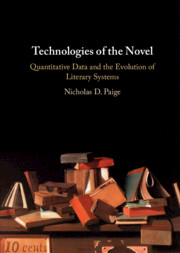
New book by Nicholas Paige - Technologies of the Novel
Posted: 30 Nov 2020 - 14:14

Technologies of the Novel – Quantitative Data and the Evolution of Literary Systems

New book by Nicholas Paige

https://www.cambridge.org/us/academic/subjects/literature/english-literature-1700-1830/tec...

Based on a systematic sampling of nearly 2000 French and English novels from 1601 to 1830, this book's foremost aim is to ask precisely how the novel evolved. Instead of simply 'rising', as scholars have been saying for some sixty years, the novel is in fact a system in constant flux, made up of artifacts – formally distinct novel types – that themselves rise, only to inevitably fall. Nicholas D. Paige argues that these artifacts are technologies, each with traceable origins, each needing time for adoption (at the expense of already developed technologies) and also for abandonment. Like technological waves in more physical domains, the rises and falls of novelistic technologies don't happen automatically: writers invent and adopt literary artifacts for many diverse reasons. However, looking not at individual works but at the novel as a patterned system provides a startlingly persuasive new way of understanding the history and evolution of artforms.

Christina Kullberg, Lire l’Histoire générale des Antilles de J.-B. Du Tertre: Exotisme et établissement français aux Îles (1625-1671)
Posted: 10 Nov 2020 - 03:27

Brill, 2020. ISBN: 978-90-04-43454-7. ISBN e-book : 978-90-04-43496-7 en libre accès. 210 p.

Cette étude propose d’examiner les ramifications historiques de l’exotisme à partir d’une lecture critique de l’Histoire générale des Antilles (1654/1667-71) écrite par le missionnaire dominicain, Jean-Baptiste Du Tertre. En procédant d’une analyse littéraire, notre étude suggère une reconfiguration de l’exotisme basée à la fois sur la théorisation contemporaine et sur le contexte historique et l’esthétique de l’époque. Notre travail se veut donc à la fois théorique en offrant une analyse critique des différentes orientations de l’exotisme ; et historique, en présentant une lecture approfondie d’une œuvre dont l’importance est considérable aussi bien pour l’histoire de la littérature française et antillaise que pour l’histoire de l’anthropologie. À cet égard, cette étude fournira aussi une exploration de la toute première colonisation française des îles et de la manière dont elle a été représentée. 

Libre accès: https://brill.com/view/title/57062

https://doi.org/10.1163/9789004434967


Pierre de L'Estoile, Journal du règne de Henri IV. Tome IV: 1599-1603, éd. Edited by Gilbert SCHRENCK, Marie-Madeleine FRAGONARD, Nancy ODDO
Posted: 5 Nov 2020 - 13:08

Transcription du Ms fr 13720 de la BnF et du Ms 1117 (1) de la Bibliothèque de Troyes. Droz, 2020. ISBN 978-2-600-06002-8. 68,98 CHF.

This text presents the fourth volume of the Memoirs-Journals from the reign of Henry IV which were kept by Pierre de l’Estoile. Beginning in 1599, this volume recounts loves, marriages, births, conspiracies, sudden deaths, strange events, wonders, and more.

https://www.droz.org/9782600060028

Online publication (Open access or subscription) :

https://textes-litteraires-francais.droz.org/book/9782600060028

Matthieu Brejon de Lavergnée, The Streets as a Cloister. History of the Daughters of Charity (17th-18th centuries)
Posted: 5 Nov 2020 - 10:10

New City Press, 2020. ISBN 978-1-56548-027-8. 668 p. $79.

The Daughters of Charity are today the largest community of Catholic women, with 15,000 sisters in about 100 countries. They devote their lives to serving the poorest in hospitals, schools, and care centers for homeless or migrants, as well as working to promote social justice. Each year, millions of Miraculous Medals are sent all over the world from their motherhouse in Paris, where Catherine Labouré had visions of the Virgin Mary in 1830. 

Until now, however, the history of the Daughters of Charity has been almost wholly neglected. The opening of their central archives, combined with access to many public and private archives, has finally allowed this to be remedied.

This volume, the fruit of several years’ work, covers the history of the Company from its foundation by Vincent de Paul and Louise de Marillac as a confraternity of young women to the suppression of the order during the French Revolution. The study, at the juncture of women’s history and religious history, shows how much the Daughters of Charity contributed to the emergence of a new and ambiguous status in post-Tridentine society: neither cloistered nuns nor married women, but “seculars.” The Company has certainly offered a framework that enabled many resolute women to lead lives out of the ordinary, taking young peasant women to the royal court, intrepid hearts to Poland, and, more generally, generous souls to the “martyrdom of charity” among the poor and the ill.

https://www.newcitypress.com/the-streets-as-a-cloister.html