Announce

Calls for Papers and Contributions

Les Contes et nouvelles en vers de La Fontaine: cerner et situer une œuvre méconnue
Posted: Saturday, December 14, 2024 - 16:36

Les Contes et nouvelles en vers de La Fontaine
cerner et situer une œuvre méconnue

Colloque international organisé par le CELLF 16-21 (UMR 8599 – Sorbonne Université / CNRS)
et la Société des Amis de Jean de La FontaineSorbonne Université – 4 et 5 décembre 2025.

Appel détaillé en ligne.

Les propositions (500 à 1000 mots), accompagnées d’une bio-bibliographie, doivent être envoyées à tiphaine.rolland@gmx.fr et dmn.fortin@gmail.com avant le 30 mars 2025.

Le colloque se déroulera les 4 et 5 décembre 2025, en Sorbonne. Les communications devront durer 25 minutes. Une publication des actes est prévue dans la revue Le Fablier dès 2026.

Les Contes et nouvelles en vers de La Fontaine : cerner et situer une œuvre méconnue
Posted: Friday, December 13, 2024 - 11:04

Colloque international organisé par le CELLF 16-21 (UMR 8599 – Sorbonne Université / CNRS)
et la Société des Amis de Jean de La Fontaine

Sorbonne Université – 4 et 5 décembre 2025.

Appel détaillé en ligne.

Les propositions (500 à 1000 mots), accompagnées d’une bio-bibliographie, doivent être envoyées à tiphaine.rolland@gmx.fr et dmn.fortin@gmail.com avant le 30 mars 2025.

Le colloque se déroulera les 4 et 5 décembre 2025, en Sorbonne. Les communications devront durer 25 minutes. Une publication des actes est prévue dans la revue Le Fablier dès 2026.

LA COMÉDIE-FRANÇAISE RACONTÉE PAR SES PUBLICS
Posted: Monday, October 21, 2024 - 18:48

Colloque international

Paris, 6 et 7 mai 2025

Comédie-Française et INHA


Comité d’organisation :

Florence Naugrette et Sophie Marchand (Sorbonne Université), Tiphaine Karsenti (Université Paris Nanterre), Sara Harvey (University of Victoria), Charline Granger (CNRS – Université Paul Valéry), Sylvaine Guyot (New York University), Agathe Giraud (Université d’Artois) et Louis-Gilles Pairault (Bibliothèque-Musée de la Comédie-Française).


           Ce colloque, adossé au programme RCF (Registres de la Comédie-Française), s’inscrit dans une série de rencontres scientifiques vouées à envisager autrement l’histoire de la Comédie-Française, en examinant comment elle a pu être racontée par ses sociétaires, ses directions et ses comités. Il s’agit, pour ce dernier volet, d’analyser la place des spectateurs dans l’histoire de ce théâtre.

            De nombreux travaux existent sur la question du public, qui étudient pour la plupart le public programmé ou fantasmé par les auteurs dramatiques et les directeurs de théâtre, et dressent un portrait théorique de cette instance indispensable au déploiement du protocole dramatique et, pour cette raison même, objet de passions et d’attentions ambivalentes. Historiens et sociologues ont, de leur côté, tenté de saisir, au moyen d’autres sources (données matérielles de la vie théâtrale, rapports de police…) une image plus précise des spectateurs réels qui, par leur diversité, invitent à parler de publics au pluriel plutôt qu’à postuler une entité unifiée et uniforme. Il s’agira, lors de ces journées d’études, de conjuguer ces approches mais aussi de faire entendre la voix de ces spectateurs, conservée par la presse, les écrits de soi et les témoignages, les anecdotes, la correspondance entretenue par certains avec l’institution et ses représentants.

            Les registres de la Comédie-Française offrent sur ces questions des aperçus nouveaux. Les registres de recettes témoignent des fluctuations de la fréquentation du théâtre et des équilibres instables qui se jouent dans la salle entre des publics que définit le type de place qu’ils occupent, lié à leur capacité financière ou aux raisons particulières qui les mènent au spectacle. Rapportées à la programmation et à la prise en compte du répertoire, ces données invitent à des interrogations multiples : peut-on identifier le succès d’un genre, d’un auteur, d’une pièce, d’une thématique, d’un ou une artiste scénique à la présence de telles ou telles catégories de spectateurs ? Le succès public est-il ou non déterminant dans les logiques de programmation ? Suit-on, dans ces mêmes processus d’élaboration de la saison, les goûts du public ? Le public particulier des représentations gratis ou des voyages à la Cour implique-t-il une modification du répertoire ? Et que dire du public « invité », bénéficiant de billets spécifiques, qui contribue à l’essor d’un imaginaire de la claque ? Peut-on interpréter sociologiquement la modification, au cours des siècles, des types de places ? Cette modification a-t-elle des implications esthétiques ? À partir de quelles sources pourrait-on prendre en compte la présence et l’éventuelle influence d’un public féminin ? Les données de l’histoire du théâtre permettent-elles une approche genrée du public ?

            Les registres d’assemblées, quant à eux, permettent de mieux saisir la manière dont l’institution tient compte des publics, des débats que suscitent ces derniers, des échanges qui existent, dans la vie administrative du théâtre, avec les spectateurs. On pourra chercher dans ces registres des traces des débats sur la pertinence de supprimer les banquettes de scène, sur les avantages des parterres debout ou assis, sur la manière de réagir aux interventions des plaisants du parterre et autres spectateurs perturbateurs, sur la naissance, aussi, d’un vedettariat qui implique un certain rapport au public. Quels sont les rapports de force et les dynamiques qui déterminent la place du ou des publics dans l’écosystème évolutif que représente la vie théâtrale entre 1680 et la fin du XIXe siècle ? Quel est l’imaginaire du public qui anime les directeurs, les comédiens et comédiennes ? Voit-on se développer dans les registres d’assemblée, comme dans la presse ou l’imaginaire collectif, des physiologies de spectateurs ? Dans l’organisation architecturale et matérielle du théâtre, quels espaces réserve-t-on aux spectateurs, au sein d’une topographie à la fois concrète et symbolique ?

            D’autres sources devront être mises à profit et confrontées aux données des archives. Celles, d’une part, que constituent les échos médiatiques de la présence des spectateurs, de leur comportement, de leur influence sur le déroulement de la séance, la fortune des œuvres et la carrière des artistes. La presse, les pamphlets divers, les recueils d’anecdotes, mais aussi les préfaces et textes théoriques contribuent, à leur manière, à l’élaboration de représentations publiques du ou des publics. Celles, d’autre part, qui restituent directement le point de vue des spectateurs : lettres privées ou publiques, conservées à la Bibliothèque de la Comédie-Française, publiées dans les journaux ou recueillies dans les correspondances ; mémoires et souvenirs de spectateurs, témoignages de réception. Quelle place occupent les spectateurs dans la culture du théâtral qui se dessine à l’époque considérée ? On pourra, dans cette optique, étudier certaines pratiques comme les adresses aux spectateurs lors des annonces ou des compliments qui ponctuent la saison, et interroger la pertinence de la notion de quatrième mur pour penser une vie théâtrale qui, souvent, fait des spectateurs des acteurs de premier plan.

           Ces interrogations, centrées principalement sur la période qui s’étend de la fin du XVIIe siècle à la fin du XIXe, n’excluent pas une réflexion sur ce que représente aujourd’hui ce théâtre dans le paysage culturel français. Y a-t-il, de nos jours, une spécificité du ou des publics de la Comédie-Française ? Parlerait-on d’un ou de plusieurs publics ? Comment l’institution a-t-elle intégré les spectateurs à son fonctionnement ? Par quels moyens nouveaux ce ou ces publics se fédèrent-ils et assument-ils une identité spectatrice ? Comment contribuent-ils à la mémoire et à l’histoire de l’institution ?

Les propositions de communications (une page max.) accompagnées d’une courte présentation bio-bibliographique sont à envoyer avant le 20 décembre 2024 aux deux adresses suivantes : Sophie.Marchand@sorbonne-universite.fr et marchand.soph@wanadoo.fr.

On the Use and Abuse of Antiquity in 18th-century life…
Posted: Thursday, October 17, 2024 - 12:58

On the Use and Abuse of Antiquity… in 18th-century life: Classical references and their subversion in the Age of Enlightenment

https://modern.huma-num.fr/cfp-on-the-use-and-abuse-of-antiquity-in-18th-century-life/

ERC ModERN – Sorbonne University – University of Chicago

International Institute of Research in Paris, University of Chicago John W. Boyer Center in Paris 22-23 May 2025

It is a well-established fact, frequently analysed by literary critics, that Greek and Roman Antiquity lies at the heart of 18th-century culture. The significance attributed to ancient authors in 18th-century collèges is often acknowledged, but references to classical figures in fact permeate all forms of the literary and visual arts, whether in the light-hearted forms of Baroque and Rococo or the austere severity of Neoclassicism. Scholars have often highlighted the idealisation of ancient socio-political models, which served as counterpoints to contemporary reflections and critiques, extending from the writings of philosophers to the proclamations and imagination of Revolutionary thinkers. The classical world was imbued with an exemplary value, conceived as an alternative framework through which to contemplate and categorise a frequently problematic present, or to advocate for political, social, and aesthetic reforms. Antiquity offered ideas and images that constituted a kind of second language through which the world of the Enlightenment could be reimagined.

However, any process of re-functionalisation and re-valorisation is inevitably accompanied by subversions, instrumentalization, and alterations. For a reference to be productive and applicable to a new and changing context, it must undergo modification that renders it relevant and exploitable, allowing it to bear meanings beyond the scope of its original formulation. In all cultural domains, ancient texts were either faithfully reproduced, critically commented upon, or openly reinterpreted according to the argumentative needs of writers, who, whether intentionally or not, projected their worldview and concerns onto these works. Precisely because Antiquity functioned as a ‘second language’, its words could only serve as instruments for the description and analysis of reality to the extent that they lost their original meaning and took on new ‘semantic’ valences, enabling them to convey content more attuned to the concerns of the time.

This colloquium aims to analyse and explore these deviations, shedding light on the highly productive dialectical play that takes place between an increasingly historicist and proto- scientific reception of the ancient world (with the emergence of disciplines such as archaeology, philology, etc.) and the still very free and fertile use of classical heritage, which was often employed with little constraint to support any and all ethical, political, or aesthetic arguments. Our goal is to identify the misunderstandings or ‘subverted’ reuses of classical texts, histories, and figures. Whether these fluctuations occur in the literal but reoriented reproduction of phrases, maxims, or passages from ancient texts, or more broadly in the reception of classical models in which new symbolic potentialities are detected, we wish to delve deeper into the qualities and purposes of these transformations of ancient material, analysing their pathways and dead ends, their distortions and their reconfigurations.

Why refer to Antiquity, and with what specific objectives or purposes? How were maxims, historical or philosophical texts, and the pantheon of ancient heroes and gods reinterpreted in the Age of Enlightenment, and how were they integrated into the contemporary cultural discourse? What demands for fidelity, and what modernising distortions were imposed upon Greek and Roman treatises and literature? How did any reappropriation of ancient discourse and its imagery ultimately prove suitable for the new expressive and ideological needs of the philosophes, and how could these same images also lead to their condemnation?

Practical Information

Proposals for papers, in French or English, consisting of 250 to 300 words, accompanied by a brief bio-bibliography including institutional affiliations, should be submitted by December 15, 2024, to the following two email addresses:

glenn.roe@sorbonne-universite.fr / dario.nicolosi.92@gmail.com

Acceptance decisions will be communicated to the authors by January 15, 2025.

Presentations, in French or English, must not exceed 30 minutes.

The conference organizers will cover travel and accommodation expenses for all invited speakers.

A publication of the conference proceedings is planned.


Colloque international

On the Use and Abuse of… Antiquity in 18th-century life: références classiques et détournements à l’Âge des Lumières

ERC ModERN – Sorbonne Université – Université de Chicago

International Institute of Research in Paris, University of Chicago John W. Boyer Center in Paris 22-23 mai 2025

Que l’Antiquité classique, grecque et latine, soit au centre de la culture du XVIIIe siècle est un fait avéré, qui a souvent été analysé par la critique littéraire. On rappelle régulièrement l’importance accordée aux auteurs anciens dans les collèges ; on remarque les références continues aux figures classiques dans toute forme d’art, littéraire ou visuel, qu’il s’agisse des formes légères du baroque et du rococo ou de la sévérité austère du néoclassicisme ; on insiste sur la récupération, souvent fantasmée, des exemples et des modèles socio-politiques antiques, qui fonctionnent en tant que repoussoirs pour des réflexions et des critiques ancrées dans la contemporanéité la plus pressante, depuis les écrits des philosophes jusqu’aux proclamations et à l’imaginaire des hommes de la Révolution. L’univers classique est investi d’une valeur exemplaire, envisagé comme un contre-modèle à travers lequel penser et catégoriser un présent souvent problématique, ou pour prôner des réformes politiques, sociales, esthétiques. L’Antiquité offre des idées et des images qui constituent une sorte de deuxième langue à travers laquelle imaginer le monde en devenir des Lumières.

Or, tout processus de refonctionnalisation et de revalorisation n’est jamais exempt de trahisons, d’instrumentalisations, d’altérations : pour qu’une référence soit productive et applicable à un nouveau contexte en mutation, elle doit faire l’objet de plusieurs modifications qui la rendent parlante et exploitable, afin d’être apte à se charger de significations dépassant le cadre originel de sa formulation. Dans tous les domaines culturels, les textes des anciens sont repris, fidèlement commentés ou ouvertement réinterprétés selon les exigences argumentatives d’écrivains qui, de manière plus ou moins volontaire, y projettent leur vision du monde et leurs préoccupations. Justement puisqu’il s’agit d’une « deuxième langue », l’Antiquité et ses mots ne s’offrent comme un instrument de description et d’analyse du réel que dans la mesure où ils perdent leur sens premier pour se prêter à un enrichissement « sémantique » qui les rend porteurs de contenus mieux accordés aux problématiques de l’époque.

Notre colloque se propose d’analyser et d’approfondir ces écarts, de mettre en lumière le jeu dialectique fructueux qui s’opère entre une réception du monde antique de plus en plus régie par des contraintes historicistes et proto-scientifiques (avec les premiers pas de disciplines telles que l’archéologie, la philologie, etc.), et une utilisation encore très libre et fertile de l’héritage classique, sollicité sans trop de contraintes pour soutenir tout argument, qu’il soit éthique, politique ou esthétique. Notre propos est d’identifier les incompréhensions ou les réemplois « détournés » des textes, des histoires et des figures classiques. Que ces fluctuations se produisent dans la reproduction littérale mais réorientée de formules, de sentences, de morceaux extraits des textes antiques ; ou qu’elles s’installent plus généralement dans la réception de modèles classiques, dans lesquels on décèle de nouvelles potentialités symboliques ; nous souhaitons approfondir les qualités et les finalités de ces transformations de la matière antique, analyser leurs chemins et leurs impasses, leurs entorses et leurs reconfigurations.

Pourquoi choisir de se référer à l’Antiquité, et avec quelles finalités ? Comment les sentences, les textes historiques ou philosophiques, les répertoires de héros et de dieux antiques sont-ils relus à l’âge des Lumières, et comment se retrouvent-ils engagés dans le discours culturel contemporain ? À quelles exigences de fidélité et à quels détours actualisants sont soumis les traités et la littérature grecs et romains ? Comment toute réappropriation de la parole antique et de son imaginaire s’avère-t-elle finalement convenable aux nouvelles exigences expressives et idéologiques des philosophes, et comment les mêmes images ont-elles pu, au contraire, se révéler fonctionnelles à leur condamnation ?

Informations pratiques

Les propositions de communication en français ou en anglais, de 250 à 300 mots, accompagnées d’une brève bio-bibliographie incluant les institutions de rattachement, sont à soumettre avant le 15 décembre 2024 aux deux adresses courriel suivantes :

glenn.roe@sorbonne-universite.fr / dario.nicolosi.92@gmail.com

Les décisions d’acceptation seront communiquées aux auteur·rice·s avant le 15 janvier 2025. Les communications, en français ou en anglais, ne pourront pas dépasser 30 minutes.

Les organisateurs du colloque prendront en charge les frais de déplacement et d’hébergement de tous les intervenants conviés.

Une publication des actes du colloque est envisagée.

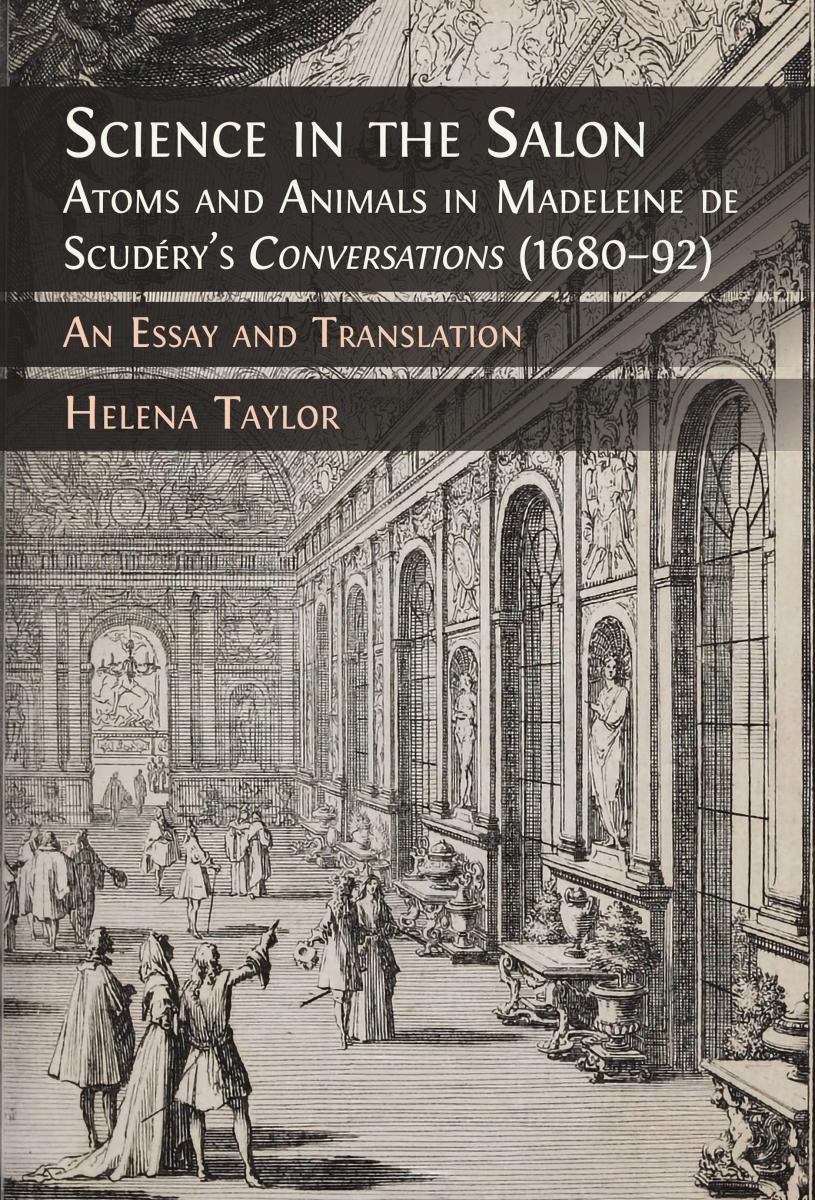
Women Writing Natural Philosophy in Early Modern Europe: Spaces and Exchanges
Posted: Sunday, September 22, 2024 - 13:41

The Cultures of Philosophy project at the University of Exeter in the UK invites proposals for our first conference, ‘Women Writing Natural Philosophy in Early Modern Europe: Spaces and Exchanges’ to be held at Reed Hall, the University of Exeter, 2-4 June 2025.

Confirmed speakers:

Cassie Gorman (Anglia Ruskin)

Ruth Hagengruber (University of Paderborn)

Sarah Hutton (University of York)

Eric Jorink (Leiden University)

Meredith Ray (University of Delaware)

Elizabeth Scott-Baumann (KCL)


The history of philosophy is experiencing a major paradigm shift, with the work of early modern women philosophers in the spotlight (for e.g. Detlefsen and Shapiro 2023): this conference builds on that momentum to produce a more inclusive account of “science” in the long seventeenth century. The conference aims to recover women’s contributions to early modern natural philosophy, looking beyond the treatise and dialogue to other genres both in manuscript and print; and to examine women’s roles in transnational communities of scientific exchange.


In particular, the conference will foreground women’s textual engagement with natural philosophy and investigate transnational institutions, communities, and collaborations. How are philosophical concepts conveyed by diverse literary forms that cannot be categorised as scholarship? How did European women draw on global perspectives and philosophical cultures outside Europe? How can we trace women’s engagement with philosophical networks and institutions? How might including different genres, figures, and communities shift our understanding of natural philosophy in this period?


Taking a comparative, relational, and transnational approach, the conference seeks to investigate women's collaborations, exchanges, and roles in networks both within or at the margins of academies, institutions, and other official sites of scientific knowledge exchange; and their involvement in informal salons, manuscript circles, and other spaces of encounter. The CultPhil project examines the European context, but we welcome papers that engage with non-European cultures and philosophical traditions, with attention to different languages, international networks, and contexts. We encourage proposals from scholars in disciplines including (but not limited to): history of science, environmental humanities, literary history, intellectual history, book history, and the history of philosophy.


Proposals could include, but are not limited to:

Female-authored writing that engages with natural philosophy within a range of genres, such as hagiography and other devotional genres, poetry, marginalia, miscellany, novels, historical fiction, salon verse, annotation, translation etc.

Women’s participation in (and exclusion from) academies, salons, manuscript circles, institutions, and other spaces of learning

Women and transnational and national manuscript and epistolary networks, exchanges, dynamics of collectivity and collaboration, circulatory systems, book history and their relations to natural philosophy

Recovery of forgotten thinkers; methods for approaching the history of (natural) philosophy

Intersections between natural philosophy and other disciplines: theology, natural history, medicine, political thought, rights of women

Women’s ecological thought

Ecofeminist and animal history readings of early modern texts

Variations in women’s intellectual conditions (both constraints and opportunities) across borders and cultural regions

Encounters, influence, entanglements with the global context

We invite proposals (200-250 words) for 20-minute papers or 10-minute lightning talks, delivered in English (please include a short biographical note of c. 50 words); we welcome proposals from PhD students and early career scholars.

Conference attendance will be free, but participants are expected to arrange and cover the costs of their own travel and accommodation. There will be a limited number of bursaries to support speakers without access to institutional funding. If you wish to be considered for a bursary, please note this with your proposal.


Deadline: November 29th 2024. Please send proposals to cultphil@exeter.ac.uk.

We envisage publishing a collected volume based on the conference proceedings.

Conference organisers (University of Exeter):

Helena Taylor

Felicity Henderson

Catherine Evans

Carlotta Moro

Floris Verhaart


The conference is supported by the European Research Council-selected Starting Grant, ‘Cultures of Philosophy: Women Writing Knowledge in Early Modern Europe’, funded by UK Research and Innovation (UKRI), under the UK government’s Horizon Europe funding guarantee [grant number EP/Y006372/1].

Grants

Short-term Visiting Scholar Research Grant French, Political Economy, Stanford Libraries

Posted 30 Jan 2020 - 14:50

Stanford University Libraries is accepting applications for a short-term research fellowship for scholars wishing to use the Gustave Gimon Collection on French Political Economy, held in the Libraries' Special Collections department. The Libraries annually awards stipends of $3000-$5000 (depending on the length of visit, expected to last from 2 to 4 weeks) in support of research in the collections. The funds can be used to defray the costs for travel, lodging, food, and other expenses associated with the recipient's research trip. This fellowship program is funded by a grant from the Flora Family Foundation.

The current application deadline is March 15, 2020. The fellowship can be used September 2020 to August 2021. The scholar should plan on visiting while the university is in session so that he or she can meet with Stanford faculty and students.

Scholars working on serious projects about French political economy may apply, including advanced graduate students at the dissertation phase of their study. Selection criteria include the relevance of Gimon Collection to the candidate's project, the contribution that the finished work will make to our understanding of French political economy, and the applicant's qualifications. The library encourages potential applicants to contact the curator, Sarah Sussman, for more information about the scope and contents of the collection.

There is no application form. Interested researchers are encouraged to send in a detailed project proposal of no more than 1000 words clearly stating why materials in the Gimon Collection are essential to carrying out the research project, two letters of recommendation from scholars in the field, and a CV.

Proposals are to be sent by April 1, 2020 to the curator Sarah Sussman ssussman@stanford.edu

About the Gimon Collection on French Political Economy

The Gustave Gimon Collection on French Political Economy contains approximately 1000 titles that concentrate broadly on the evolution of French economics and politics from the late sixteenth to the mid nineteenth century. Because the Gimon Collection embodies a broad definition of political economy and because its materials span the three centuries from 1550-1850, scholars working in fields as varied as History, Literature, Art History, Economics, and Philosophy are invited to apply for an opportunity to work in the collection. The collection is particularly strong in material from the eighteenth and nineteenth centuries. Topics of focus include Physiocracy, nineteenth century utopian thought (Saint-Simonianism and Fourierism), workers' rights, and how economic, social, and political thought was applied to issues as varied as religious freedom, political sovereignty, taxation and trade policies, colonial issues, agriculture, and transportation. The scholar will also be able to use other materials held in Stanford Libraries, which contain rich holdings of French historical works. 

Bibliography of the Collection 

For more information about Stanford University Libraries:  http://library.stanford.edu/

For more information contact: Sarah Sussman ssussman@stanford.edu  650-723-9481

RSA 2020 Research Fellowships (application deadline: 15 September 2019)

Posted 14 Aug 2019 - 22:52

The Renaissance Society of America is pleased to announce that our 2020 Research Fellowships competition is now open. For the 2020 cycle, the RSA will award fellowships of $3,000 to scholars working in the field of Renaissance studies (1300–1700). Fellowships are made possible by donations and bequests from RSA members and grants from the Samuel H. Kress Foundation.

A link to the application site and details about the application process, eligibility, residential fellowships, non-residential fellowships, and publication subventions are available on the RSA Fellowships webpage. The deadline to apply is 15 September 2019.

To submit an application, you must be a current RSA member. If you are not a current member, please renew your membership before applying for a fellowship. RSA memberships are valid for a full twelve months from the time of renewal.

Model proposals and statistics about previous fellowship cycles available on the RSA Fellowships webpage provide additional information about the application process.

During the past five years, the RSA has awarded fellowships to more than 100 scholars at all career stages, working on topics from the fourteenth to the seventeenth century in many different fields. A list of previous award winners is posted on the RSA website.

2019 WSFH Millstone Fellowship

Posted 4 Feb 2019 - 15:37

The Millstone Fellowship provides $2500 for research in France.  Eligibility is restricted to doctoral students, untenured and adjunct faculty members, and independent scholars who reside in North America and whose research related to French history and culture requires work in archives, libraries, or other repositories in France.  Preference is given to doctoral students and scholars in the early stages of their academic careers.


Applications are due by March 15, 2019.  Proposals will be reviewed by a five- member committee chaired by the Vice-President of the WSFH.  Winners will be notified by May 2019, and the awards will be announced at the Society's annual meeting to be held in Bozeman, Montana in October 2019.


For detailed information about application procedures, please consult the WSFH website at:  https://www.wsfh.org/prizes-and-grants/

Society for French Studies: Visiting International Fellowship

Posted 15 Jan 2019 - 19:52

The Society for French Studies is pleased to accept applications for the 2019 Visiting International Fellowship scheme.The deadline for this round is 1 April 2019. The scheme is intended to support an annual visiting fellowship, tenable in any UK or Irish university, or institution of higher education in the UK or Ireland, to allow outstanding academics in the French Studies field based in overseas universities to spend time at UK or Irish higher education institutions. 


In order to extend the global reach of the scheme, the Society has increased the maximum value of the award to £5,000 and extended the maximum length of the Fellowship to eight weeks. It strongly encourages applications to support visits from scholars in all parts of the world, including Africa, Australasia and the Caribbean. The key objective of the Fellowship grant is to encourage the internationalization of French Studies in the UK and Ireland through engagement with those active in the field elsewhere. It is also intended that the Fellow will use the occasion to further their own academic interests, and to visit more than one UK institution. Visits should be of no more than eight weeks’ duration, although an extended period may be appropriate if additional funding is available from institutional sources.


Full details of how to apply are on the Society’s website: www.sfs.ac.uk/funding-visiting-fellowships/.


Applications must be completed by an academic member of staff in the UK or Irish host institution. The UK or Irish host applicant is also expected to organise, direct and take academic and organisational responsibility of the fellowship. Host applicants must be members of or associated with Higher Education departments of French (or departments which teach French) in the UK and Ireland. Main applicants must also be members of the Society for French Studies. No more than one application may be submitted by any institution in one academic year (this applies to collegiate and non-collegiate universities alike, and includes joint applications from two or institutions).


The Society will offer a grant of up to £5,000 to support travel, accommodation, subsistence and other expenses; up to an additional £500 is also available to cover the costs of visiting other institutions in the UK or Ireland. Personal expenditure on items such as visa costs, car hire and health insurance are not eligible, and it is expected that host institutions will offer support for these. Application for this award will be competitive, and it cannot be made retrospectively. Informal enquiries can be directed to Professor Edward Welch, University of Aberdeen, edward.welch@abdn.ac.uk.


Visiting Fellowship at St Andrews, Centre for French History and Culture

Posted 10 Jan 2019 - 12:25

The Centre for French History and Culture of the University of St  Andrews (UK) invites applications for a Sabbatical Visiting Fellowship, to be taken up during either semester of the academic year 2019-20. It is envisaged the Fellowship will last 2-3 months (by negotiation).


The Fellowship is open to any academic across the world in a permanent or tenure-track faculty post with research interests in any period of French history or French colonial history. Prospective applicants who are unsure whether they qualify should email the Director (see below). The tenure of the Fellowship might particularly suit academics in the later stages of writing up a substantial piece of research. The Fellowship provides a stipend of £3000, intended to cover the cost of transportation to and from St Andrews from the holder's normal place of work and to defray accommodation costs while the holder is resident in St Andrews. The Fellowship carries with it no teaching duties, though the Fellow is expected to present a research paper and to take part in the normal seminar life of the Centre and the School of History during his or her stay in St Andrews. The Fellow will have full borrowing and e-access rights in the university library.


To apply please send an application consisting of:

(1)       a covering letter outlining your proposed programme of research (maximum 1000 words)

(2)       a short CV (no more than 4 pages)

(3)       a list of publications (maximum 2 pages)

(4)       the names and addresses of two referees we might choose to approach

to the co-director, Dr Justine Firnhaber-Baker (cffhc@st-andrews.ac.uk).


If there is anything else you would like to draw to our attention to help your application, please mention it in a short covering email.


The closing date for applications is 1pm (GMT) on Friday 15 February 2019. The result of the competition will be communicated to applicants by early March.


The activities of the Centre for French History and Culture, and its staff, can be viewed on its website: http://cfhc.wp.st-andrews.ac.uk/. Previous holders of this Visiting Fellowship include Professor Norman Ingram (Concordia University, Canada), Professor Eric Jennings (University of Toronto, Canada), Professor Junko Takeda (Syracuse University), Professor Dominique Kalifa (Paris I – Panthéon Sorbonne), and Professor Nélia Dias (ISCTE – Instituto Universitário de Lisboa).


Jobs

Assistant Professor of French Studies at Susquehanna University
Posted 26 Sep 2025 - 07:00

Job Summary

The Department of Languages, Literatures & Cultures at Susquehanna University invites applications for a tenure-track position in French Studies at the rank of Assistant Professor beginning in August 2026. Candidates must have native or near-native fluency in French and a solid record of student-centered teaching. They must demonstrate an ability to teach French language at all levels as well as a range of courses in French and Francophone cultural and literary studies. The teaching load is 3 courses per semester. Demonstrated success or evidence of potential to excel in teaching and advising undergraduates is essential, as is ongoing scholarly productivity and institutional service.

Minimum Qualifications

An earned doctorate in French or Francophone studies (or a related field) is required by date of appointment. A strong commitment to teaching in a liberal arts environment will be essential.

Additional Information for Applicant

Please submit an online application including a cover letter, CV, and three letters of recommendation online. Inquiries should be sent to Dr. Greg Severyn, Chair of the Search Committee: severyn@susqu.edu. Applications are due by November 7.

For more information and to apply, follow this link:

https://www.schooljobs.com/careers/susqu/jobs/5091539/assistant-professor-of-french-studies


Assistant Professor at the University of Nevada, Reno
Posted 26 Sep 2025 - 06:52

The Department of World Languages & Literatures at the University of Nevada, Reno invites applications for a full-time tenure-track position in French. The appointment will be at the rank of Assistant Professor, with an anticipated start date of July 1, 2026.

The successful candidate will contribute to our undergraduate and master’s programs in French as well as the Basic French Language Program. We seek a scholar with expertise in any area of French-language literary studies, or with a French-language specialization in Cultural Studies, Media Studies, or Digital Humanities; primary consideration will be given to scholars with demonstrated familiarity with the Digital Humanities.

The position will involve teaching courses in French language, literature, and culture at all levels, including Basic French Language classes, and will also be expected to develop and teach courses that integrate Digital Humanities approaches into the discipline. Candidates will have an established or clearly developing research agenda and will be expected to sustain and lead innovative and independent research at the highest level while giving evidence of, or showing strong potential to, attract external grant funding.

In addition to teaching and research, the successful candidate will hold service responsibilities and actively contribute to advising, recruitment, and extracurricular programming in French, helping to build and sustain a vibrant intellectual and cultural community for our students. Tenure-track faculty who teach at the master’s level have a 3/3 teaching load. Applicants with evidence of attention to diversity, equity, and inclusion in research, teaching and/or service are encouraged to apply.  

For full consideration, applications must be received by October 24th, 2025.

For more information and to apply, follow this link.


Assistant Professor of French at Transylvania University
Posted 10 Sep 2025 - 11:49


Transylvania University (www.transy.edu), a top-tier, independent, residential liberal arts college in Lexington, Kentucky, invites applications for the position of Assistant Professor of French. This is a tenure-track position, teaching in-person classes, beginning August 27, 2026. Transylvania University recognizes that a diverse and inclusive community is essential to the fulfillment of our mission as a liberal arts institution. To that end, we seek to attract a diverse faculty skilled in the scholarship of teaching, research, and mentorship of students from a variety of backgrounds.


Job Responsibilities

We seek a dynamic colleague in any field of specialization within French/Francophone Studies who will contribute to the growth and vitality of French at Transylvania. Transylvania University is known for a culture of excellence in teaching, so the successful candidate should have a strong interest in teaching in a liberal arts setting. The successful candidate will teach all levels of French language as well as advanced-level courses in the candidate’s area of specialization. In addition to occasional contributions to first-year programming and service as an academic adviser, there are opportunities to collaborate across disciplines while working closely with Africana Studies, Film Studies, Medical Humanities, etc. The teaching load consists of three courses per term, plus one short-term course in May (3-3-1) that offers additional opportunities for travel courses, team-taught courses and other more experimental classroom endeavors. Other responsibilities include scholarship/professional activity and service to the university through various committee appointments. The university also has an excellent faculty development program that competitively funds faculty (and student) scholarly research and artistic projects.


Qualifications

A Ph.D. in French or related field is required by the start date. The successful candidate will have native or near-native fluency in French and English, a commitment to teaching and student engagement, an active research agenda in the field of specialization, and interest in working collaboratively across disciplines within a liberal arts environment.


To begin the application process, submit a cover letter and one PDF that contains your curriculum vitae, unofficial graduate transcripts, and a brief teaching philosophy statement. Candidates are encouraged in their cover letter to express how they see themselves excelling in an inclusive liberal arts context and how they would contribute to the growth and vitality of the French program. Please upload your cover letter and your PDF separately at the job openings link at http://www.transy.edu/jobs. If you are selected to move forward in the application process, you will be asked to provide official graduate transcripts and letters of recommendation at a later date. Send questions specific to this search to Dr. Brian Arganbright, search committee chair, at barganbright@transy.edu.  Review of applications will begin on September 15, 2025 and will continue until an appointment is made.


Transylvania University is ranked in the top 15 percent of the nation’s four-year colleges by the Princeton Review, which cites its community-driven, personalized approach to a liberal arts education through 49 majors and 40 minors. Founded in 1780, it is the 16th oldest institution of higher learning in the country, with approximately 1,000 students.


Transylvania University is an Equal Opportunity Employer and is committed to enhancing the diversity of the university community. In support of this goal, we seek qualified candidates with a wide range of backgrounds, perspectives, and experiences. We embrace diversity and encourage all who are interested to apply.


Assistant or Associate Professor of French and Francophone Performance Studies at Middlebury College
Posted 9 Jul 2025 - 06:08

Open Rank, Tenure-track Professor of French and Francophone Studies, Middlebury College, MIDDLEBURY, VT -- The Lois '51 and J. Harvey Watson Department of French and Francophone Studies invites applicants for an Assistant or Associate Professor position in the field of French and Francophone Performance Studies, including specialists on Theater, Music, Dance, Film and Media Studies of any century and any region of the Francophone world beginning fall 2026. Additional expertise in any of the following fields is highly desirable: digital humanities, gender and sexuality studies, race, or conflict resolution. Ideal candidates will be interested in working in a collaborative environment in a small liberal arts college setting. Applicants must have native or near native command of French (this includes all its varieties: European, Caribbean, North American, African, etc.) and should have completed all Ph.D. requirements by August 2026. Candidates who are already in Assistant or Associate professorial positions will be considered. Candidates must show evidence and/or promise of excellence in teaching students from diverse backgrounds and have an active research agenda. We are seeking outstanding teachers with demonstrated experience in teaching French language at all levels in an immersive environment.

As part of a full teaching load, the candidate will also occasionally contribute to Middlebury's First Year Seminar Program and Winter Term course offerings. All faculty at Middlebury are also expected to contribute to service to the College including, but not limited to, committee membership and serving as Director or Chair of a Program or Department when asked.

Middlebury College is a top-tier liberal arts college with a demonstrated commitment to excellence in both faculty teaching, research, and service. It is also an Equal Opportunity Employer committed to fostering a truly open, and supportive learning, teaching, and working environment. The College hires faculty from a myriad of life experiences, cultures, frames of reference, social identities, and learning perspectives to help cultivate and advance innovation in our curriculum and to provide a rich and varied educational experience to our talented and distinguished student body. All qualified applicants will receive consideration for employment without regard to race, color, religion, sex, sexual orientation, gender identity, national origin, disability, age or protected veteran status.

Middlebury College uses Interfolio to collect all faculty job applications electronically. Email and paper applications will not be accepted. At Middlebury, we strive to make our campus a respectful, engaged community that embraces difference, and a full range of views and opinions, with all the complexity and individuality each person brings. Through Interfolio submit: a letter of application addressed to the chair, William Poulin-Deltour; a curriculum vitae; undergraduate and graduate transcripts; a statement of teaching and research plans; and three current letters of recommendation, at least two of which must speak to teaching ability/promise. More information is available at https://apply.interfolio.com/168479 and https://www.middlebury.edu/college/academics/french. The application deadline is August 31, 2025.

Offers of employment are contingent on completion of a background check. Information on our background check policy can be found here: http://go.middlebury.edu/backgroundchecks


Visiting Assistant Professor of French at Allegheny College
Posted 9 May 2025 - 15:57


The Department of World Languages & Cultures at Allegheny College (Pennsylvania, USA) invites applications for a Visiting Assistant Professor of French for a two-year position, beginning in Fall 2025.


We seek a dynamic teacher-scholar with experience teaching French at all undergraduate levels. The successful candidate will support and sustain our French minor program and collaborate closely with a native-language assistant to develop engaging co-curricular programming. Area of specialization is open.


  • MA required; PhD or ABD preferred
  • Native or near-native fluency in French and English
  • 3/3 teaching load
  • Strong commitment to undergraduate teaching and inclusive pedagogy


To apply, please submit a CV and letter of interest to: employment@allegheny.edu or by post: Office of Human Resources, Allegheny College, 520 N. Main Street, Meadville, PA 16335, USA.   Letters of recommendation (one addressing teaching) will be requested at a later stage. Review of applications is ongoing.


Allegheny College is a selective liberal arts institution featured in Colleges That Change Lives and recognized for excellence in undergraduate teaching. We are committed to building an inclusive community and strongly encourage applications from members of underrepresented groups.


More information: www.allegheny.edu


Scholarships Available

National Humanities Center Residential Fellowships 2018–19
Posted: 15 Sep 2017 - 03:02

National Humanities Center Residential Fellowships 2018–19 Call for Applications

The National Humanities Center invites applications for academic-year or one-semester residencies. Mid-career as well as senior scholars from all areas of the humanities are encouraged to apply; emerging scholars with a strong record of peer-reviewed work are also invited to apply.

Located in the vibrant Triangle region of North Carolina, the Center affords access to the rich cultural and intellectual communities supported by the area's research institutes, universities, and dynamic arts scene. Fellows enjoy private studies, and superb library services deliver all research materials. Scholars from all parts of the globe are eligible; stipends and travel expenses are provided. Fellowship applicants must have a PhD or equivalent scholarly credentials. Fellowships are supported by the Center's own endowment, private foundation grants, contributions from alumni and friends, and the National Endowment for the Humanities.

Applications are due by October 18, 2017. For more information and to apply, please begin your application here.

Visiting fellowships, National University of Ireland, Galway
Posted: 13 Aug 2017 - 10:22

Dear colleagues,

I would like to draw your attention to short-term visiting fellowships now available for research and/or writing-up at my university, National University of Ireland, Galway.  These are tenable for up to one month between October 2017 and May 2018, and the closing date for applications is 1st September 2017.  

For H-France scholars, the fellowship may provide a welcome period of writing time, at a university with good library and digital resources, easy access to the National Library, and the potential to connect productively with NUIG scholars of French history and literature, colonialism and post-colonialism, religious history, women's history, digital humanities, and more.

Please click on http://mooreinstitute.ie/2017/08/09/moore-institute-visiting-research-fellowships-now-available/ for further information.  I am happy to answer informal queries from anyone interested in applying.

Best wishes, Alison Forrestal

Dr. Alison Forrestal,

History,

School of Humanities,

National University of Ireland, Galway, Galway, Ireland

00 353 (0)91 495629

Camargo Core Program
Posted: 24 Jul 2017 - 18:29
The Camargo Foundation, located in Cassis, France, and founded by artist and philanthropist Jerome Hill, is a residential center offering programming in the humanities and the arts. It offers time and space in a contemplative environment to think, create, and connect for scholars, artists, and thinkers in the arts and humanities. This call is open until October 17, 2017.

For the Camargo Core Program, the Camargo Foundation welcomes applications from all countries, nationalities, and career levels.

• Scholars & Thinkers (including professionals and practitioners in creative fields such as curators, critics, urban planners, independent scholars, etc.) should be connected to the Arts and Humanities  working on French and Francophone cultures, including but not limited to cross-cultural studies that engage the cultures and influences of the Mediterranean region.
• Artists, in all disciplines, who are the primary creators of a new work/project. The Camargo Core Program encourages multidisciplinary and interdisciplinary approaches.
 

Residency periods:

• Fall 2018 (8 weeks from September 11  to November 6)
• Spring 2019 (6 weeks from February 26 to April 9 / 8 weeks from February 26 to April 23 / 11 weeks from February 26 to May 14)
 

Number of fellowships: 18 Fellowships/year, 9 artists and 9 scholars & thinkers

Stipend: A stipend of 250 USD per week is available, as is funding for basic transportation to and from Cassis for the Fellow for the residency. In the case of air travel, basic coach class booked far in advance is covered.

Accompanying family members: Spouses/adult partners and dependent minor children above 6 years old may accompany fellows for short stays or for the duration of the residency. 

 
Click here to learn more about the call. 


Fleur Marin-Lamellet <fmarin@camargofoundation.org>

Call for application for research stays at the Collegium. Institute of Advanced Studies of Lyon
Posted: 18 May 2017 - 21:04

Members of this list in office in a foreign academic institution are welcome to apply for a stay at the Collegium. Institute of Advanced Studies  of Lyon during the year 2018-2019. Specialist of French studies will easily find partnerships and supports by different research teams belonging to the University of Lyon. We are available to help you to prepare your application. All details below with the link to our website and to the European Eurias programme. best regards Hervé Joly Historian, director of the Collegium. IAS of Lyon herve.joly@universite-lyon.fr  

Call for application for research stays at the  

Collegium. Institute of Advanced Studies of Lyon 

during the academic year 2018-2019


For ten years, The Collegium. Institute of Advanced Studies (IAS) of Lyon, component of the Université de Lyon and member of the Réseau français des instituts d’études avancées (RFIEA, French IAS network), has welcomed high level researchers for middle-term stays (5 or 10 months) in partnership with local research institutes. 


The Collegium recently published its new call for applications for stays during the academic year 2018-2019. The files have to be submitted before 30th September 2017; the results will be given in December after examination by the scientific council and validation by the executive committee.


This call is open to researchers in all academic fields, holding a PhD, under a work employment contract in a foreign university or research institution. The candidates can submit original projects on any theme or projects on specific research themes in partnership with local institutions. Generally speaking, projects within the scope of one of the three priority themes of the IDEXLYON (Initiative d'excellence) will be reviewed sympathetically. The three IDEX themes are Bio-Health and society, Science and engineering, and Humanities and urbanity. To be admitted, each applicant must have the support of at least one lab or research team from the University of Lyon.


The application form, as well as the guidelines for filling it, are available on the website:

www.collegium-lyon.fr/applications-24935.kjsp?RH=IEA_010000ANG&RF=IEA_090100ANG


Until 8th June 2017, researchers interested by a stay at the Collegium de Lyon have also the opportunity to apply through theEuropean programme Eurias, shared by many IAS in Europe.

www.2018-2019.eurias-fp.eu/


For any further information needed : collegium@universite-lyon.fr

Visiting Scholar Research Fellowship – French Political Economy
Posted: 30 Mar 2017 - 21:39

Stanford University Libraries

Stanford University Libraries is accepting applications for a short-term research fellowship for scholars wishing to use the Gustave Gimon Collection on French Political Economy, held in the Libraries' Special Collections department. The Libraries annually awards one stipend of $3000-$5000 (depending on the length of visit, expected to last from 2 to 4 weeks) in support of research in the collections. The fellowship stipends are to be used to defray the costs for travel, lodging, food, and photocopying associated with the recipient's research trip. This fellowship program is funded by a grant from the Flora Family Foundation.


The current application deadline is April 30, 2017. The fellowship can be used September 2017 to August 2018. The scholar should plan on visiting while the university is in session so that he or she can meet with Stanford faculty and students.

Scholars working on serious projects about French political economy may apply, including advanced graduate students at the dissertation phase of their study. Selection criteria include the relevance of Gimon Collection to the candidate's project, the contribution that the finished work will make to our understanding of French political economy, and the applicant's qualifications. The library encourages potential applicants to contact the curator, Sarah Sussman, for more information about the scope and contents of the collection.

There is no application form. Interested researchers are encouraged to send in a detailed project proposal of no more than 1000 words clearly stating why materials in the Gimon Collection are essential to carrying out the research project, two letters of recommendation from scholars in the field, and a curriculum vitae.


Proposals are to be sent by April 30 via email to:


Sarah Sussman, Curator French and Italian Collections

Gimon Collection Visiting Scholar Fellowship

ssussman@stanford.edu

About the Gimon Collection on French Political Economy

The Gimon Collection contains approximately 1000 titles that concentrate broadly on the evolution of French economics and politics from the late sixteenth to the mid nineteenth century. Because the Gimon Collection embodies a broad definition of political economy and because its materials span the three centuries from 1550-1850, scholars working in fields as varied as History, Literature, Art History, Economics, and Philosophy are invited to apply for an opportunity to work in the collection. The collection is particularly strong in material from the eighteenth and nineteenth centuries. Topics of focus include physiocracy, nineteenth century utopian thought (Saint-Simonianism and Fourierism), workers' rights, and how economic, social, and political thought was applied to issues as varied as religious freedom, political sovereignty, taxation and trade policies, colonial issues, agriculture, and transportation. The scholar will also be able to use other materials held in Stanford University Libraries, which contain rich holdings of French historical works.


For a more detailed description of the Gustave Gimon Collection on Political Economy, please see the following webpage :

http://library.stanford.edu/guides/gustave-gimon-collection-french-political-economy

For more information about Stanford University Libraries, please refer to the following URL that gives access to Searchworks, Stanford's library online catalogue:

http://library.stanford.edu/

For more information, including a title list, contact: Sarah Sussman at ssussman@stanford.edu or 650-723-9481


Sarah Sussman

Curator, French and Italian Collections

Head, Humanities and Area Studies Resource Group

Stanford University Libraries

Stanford, CA 94305

t: 650.723.9481

f: 650.725.1068

New Publications

The Jesuit "Relations". A Biography: The story of the Jesuit Relations from New France, from conception to reception - Micah True
Posted: 11 Dec 2025 - 05:35

Micah True, The Jesuit "Relations". A Biography: The story of the Jesuit Relations from New France, from conception to reception, McGill-Queens University Press, 2025.


The Jesuit Relations, a series of annual reports produced between 1632 and 1673 detailing the experiences of Society of Jesus missionaries in what is now Eastern Canada, have long been an influential source on the history of New France and encounters between European settlers and Indigenous Peoples. The question of what exactly the Relations are, and who had a hand in composing the versions that circulated, has been given far less attention.

The Jesuit "Relations" challenges conventional descriptions of these annual reports as narratives crafted solely by Jesuit missionaries. Micah True demonstrates that they were in fact shaped by a diverse array of contributors, including Indigenous people, lay settlers, nuns, editors in Paris, and readers in France. The Relations were also the product of contextual factors, he explains, such as the longstanding Jesuit epistolary tradition, the annual rhythms of the shipping schedule, and the Parisian book trade, and he details the connections between the published Relations and other texts written at the time. Tracing the history of readers' encounters with the Relations, True analyzes the three major editions that have appeared since the mid-nineteenth century, showing how each of them presents the reports differently, and how these differences have influenced scholars' understanding of the texts.

Shining a new light on the Jesuit Relations, True reveals a richer and more complex picture of a primary source that has played a major role in public understanding of the colonial history of North America.

Plus d'information ici.

Françoise d’Aubigné, Marquise de Maintenon, Dramatic Proverbs - trans. Paige Tierney, intro and ed. Theresa Varney Kennedy
Posted: 11 Dec 2025 - 05:29

Madame de Maintenon’s Dramatic Proverbs, transl. Paige Tierney, intro and ed. Theresa Varney Kennedy, The University of Chicago Press, 2025.

– a witty and engaging English translation of the short proverb plays composed for Maintenon’s students at Saint-Cyr. 

This volume, part of "The Other Voice in Early Modern Europe: The Toronto Series" (Vol. 111), features a spirited English translation by Paige Tierney, with annotations and an introduction by Theresa Varney Kennedy.

We're honored to have an endorsement from the late Perry Gethner. 

Now available from Iter Press.

La Beaumelle contre Voltaire - éd. Hubert Bost
Posted: 11 Dec 2025 - 05:22

La Beaumelle contre Voltaire, éd. Hubert Bost, Paris, H. Champion, 2025.


"Il manque un tome à la Voltairomanie". Édition par Hubert Bost et Claude Lauriol

La Beaumelle (1726-1773), admirateur critique du grand poète Voltaire dès son adolescence, a été un adversaire d’autant plus redouté que sa plume acérée puisait ses arguments dans une vaste érudition. Malgré les menées de Voltaire qui pendant vingt ans le dénonce aux autorités pour le faire taire, ce polémiste-né ne s’en est jamais laissé compter : « En colère, de sang-froid, vous me trouverez toujours sur vos pas ».


Cette édition, qui rassemble les écrits que La Beaumelle a consacrés à la personne et aux œuvres de Voltaire, permet de contrebalancer la caricature que celui-ci a réussi à imposer de son jeune et intrépide adversaire décédé quelques années avant lui.

On trouvera dans le tome I :
– les notes critiques de La Beaumelle sur le Siècle de Louis XIV (1753) et sa cinglante Réponse au Supplément du Siècle de Louis XIV (1754) ;
– le texte du manuscrit inédit « Voltaire à Berlin », rédigé en 1753-1754 ;
– Les Lettres de M. de La Beaumelle à M. de Voltaire (1763), refonte largement augmentée de sa Réponse et les brouillons de lettres inédites de 1767 à Voltaire sur un projet d’édition critique de ses œuvres.

On trouvera dans le tome II :
– la Lettre de M. de La Beaumelle à MM. Philibert et Chirol (1770) ;
– l’édition annotée de la Henriade par La Beaumelle dans ses deux versions : La Henriade avec des remarques (1769- 1770) et le Commentaire sur la Henriade (1775) posthume ;
– un choix de notes volantes manuscrites prises par La Beaumelle en vue d’une édition annotée des œuvres de Voltaire ;
– l’index général.

Plus d'infomations ici.

Madame Guyon et l'ordre secret des Michelins. Mystique et politique à la cour de Versailles - Mariel Mazzocco
Posted: 11 Dec 2025 - 05:18

Mariel Mazzocco, Madame Guyon et l'ordre secret des Michelins. Mystique et politique à la cour de Versailles, Paris, H. Champion, 2025


Figure atypique de l’histoire littéraire et religieuse de l’âge moderne, Jeanne-Marie Bouvier de La Motte (1648-1717), plus connue sous le nom de Madame Guyon, occupe une place controversée dans les débats intellectuels du XVIIe siècle. Si elle a souvent été étudiée en lien avec la querelle du quiétisme, les implications sociales et politiques de sa pensée restent encore largement inexplorées. À partir de 1689, après une vie itinérante jalonnée de péripéties, Mme Guyon avait alimenté à la cour de Versailles un cercle mystique, en séduisant l’entourage proche de Louis XIV et en rassemblant autour d’elle un petit groupe de courtisans influents, ainsi que Fénelon, précepteur du petit-fils du roi. C’est dans ce contexte qu’émerge l’ordre secret des Michelins, rêvant d’établir le « Règne du pur amour » avec l’accession au trône du duc de Bourgogne. Utopie mystique, jeu spirituel, ou véritable projet à visée politique ? À travers un langage spirituel novateur, souvent teinté d’humour, Mme Guyon déconstruit les stéréotypes sociaux, bouleverse l’ordre établi et fait de l’impossible une possibilité. S’appuyant sur des manuscrits et documents rares, Mariel Mazzocco révèle l’histoire fascinante de cette confrérie secrète née au coeur de Versailles et animée par des idéaux à la fois audacieux et subversifs.

Plus d'informations sur le site de l'éditeur.

Le voyage extraordinaire d'Élie Neau : du forçat pour la foi au catéchiste des esclaves noirs - RUTH WHELAN
Posted: 11 Dec 2025 - 05:15

RUTH WHELAN, Le voyage extraordinaire d'Élie Neau : du forçat pour la foi au catéchiste des esclaves noirs, Paris, H. Champion, 2025.


Élie Neau (1662-1722), modeste marin saintongeais, est célèbre des deux côtés de l’Atlantique. Ce protestant est connu en France comme galérien-bagnard au Château d’If sous Louis XIV, et aux États-Unis comme catéchiste auprès des esclaves noirs de New York. On présente ici, pour la première fois, les deux volets de cette vie hors du commun réunis et reliés l’un à l’autre. Une nouvelle édition annotée de l’Histoire abrégée (1701) des souffrances de Neau, est précédée d’une enquête approfondie sur la construction du récit comme histoire de martyre, sur son auteur, Jean Morin, et sur la spiritualité du héros éponyme.

Plus d'informations sur le site de l'éditeur.

Conferences and Colloquia

Entretiens de Musique Ancienne en Sorbonne 2024 : 13-14 juin
Posted: 30 May 2024 - 05:51

Énigmes, canons, allégories dans la musique ancienne

Journées d’études doctorales · Institut de Recherche en Musicologie · Sorbonne Université – ED V Concepts et Langages · Association Musique ancienne en Sorbonne

Vendredi 13 et samedi 14 juin

Amphi Gouhier, centre Clignancourt (2 rue Francis de Croisset, 75018 Paris)

Programme complet.

Inscription obligatoire.

Table ronde autour du livre de Matthieu Dupas
Posted: 16 May 2024 - 05:35

Samedi 25 mai, de 9h00 à 12h00 

sur le campus Nation de la Sorbonne Nouvelle (salle C 402), le mouvement Transitions organise une table ronde 

autour du livre de Matthieu Dupas : 

La Galanterie comme mode de vie. Amour, civilité et mariage dans Mélite ou Les Fausses Lettres de Pierre Corneille,

(Paris, Classiques Garnier, 2023).

avec Hélène Merlin-Kajman, Sarah Nancy, Françoise Poulet, Brice Tabeling, et en présence de l'auteur.


Matthieu Dupas est Assistant Professor au département de Français et d'Italien de Northwestern University (Chicago, USA). Il propose de lire Mélite ou Les Fausses lettres (1629) de Pierre Corneille à la lumière de l’histoire et de la théorie du genre et de la sexualité afin de mettre au jour la structure historique et sociopolitique de la galanterie du XVIIe siècle.

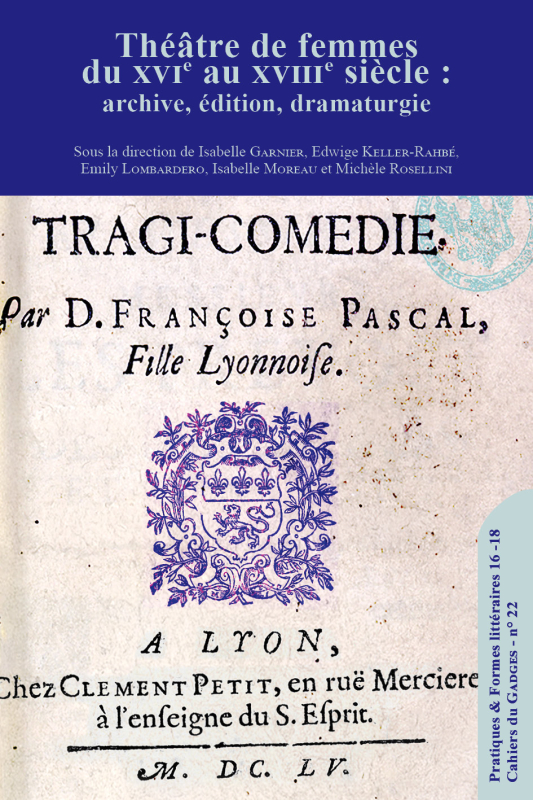
Théâtre de femmes et femmes au théâtre : dramaturges, traductrices, actrices et critiques de théâtre en Europe du XVIIe au XIXe
Posted: 2 Feb 2024 - 05:09

« Les compétences des femmes en matière de théâtre, roman, poésie, essais et lettres, brochures pamphlets, articles de journaux ainsi que dans le domaine de la traduction ont notoirement contribué à la culture et à la société du temps, et en ont infléchi le cours »[1], ainsi s’exprime, dans un ouvrage de synthèse récent sur l’écriture féminine au XVIIIe siècle en France, Christie McDonald, en évoquant une réalité qu’un nombre croissant de travaux ne cesse d’explorer depuis des décennies en Europe et ailleurs.

Ce colloque entend apporter une contribution aux recherches qui visent à donner une visibilité et une évaluation critique aux « compétences » intellectuelles des femmes, en ciblant particulièrement le domaine théâtral. Pour cela, il entend comparer les situations et les évolutions en Europe du XVIIe au XIXe siècle. En effet, durant cette période, semble se développer une « volonté commune d’affirmer l’auteurité féminine »[2]. Le colloque s’intéressera donc à cette affirmation progressive.

Du XVIIe au XIXe siècle, le théâtre semble occuper une place intermédiaire, pour ce qui est de l’accessibilité des femmes à la création intellectuelle et artistique, entre la poésie, le roman, le journalisme, l’écriture épistolaire – des genres qu’elles pratiquent de plus en plus, donc objets de la recherche contemporaine –  et l’essai érudit ou scientifique, la prose historique, le poème épique entre autres, considérés par la société intellectuelle du temps comme plus élevés, fréquentés dans une proportion bien moindre par les femmes.

Cet espace « intermédiaire » pourra être interrogé selon quatre axes principaux, quoique non exclusifs :

L’exploration des œuvres des dramaturges et librettistes qui écrivent pour la scène (nombreuses) et qui arrivent à se faire représenter ou à mettre en scène elles-mêmes leurs pièces (beaucoup moins nombreuses).

L’activité des traductrices de théâtre et des critiques femmes qui écrivent des comptes-rendus des spectacles ou du théâtre imprimé.

La participation des femmes aux discussions esthétiques et théoriques sur le théâtre et à la promotion, la circulation et la représentation des pièces.

Le travail des actrices œuvrant en contact avec les dramaturges dans la construction de leurs personnages et de la mise en scène théâtrale.

On pourra en particulier se demander comment écrivent les femmes et ce qu’elles écrivent des femmes, autrement dit comment les femmes investissent ces champs, étant donné la contrainte qui pèse sur leur rôle social et donc sur leur production littéraire et critique. Il sera intéressant d’explorer les subtilités de leur discours implicite afin de voir si émerge une poétique du féminin propre à certaines aires culturelles ou plus largement européenne.

Les propositions de communication (2000 signes environ), assorties d’une brève notice bio-bibliographique, sont à envoyer pour le 30 avril 2024 conjointement à Morgane Kappès-Le Moing (Morgane.Kappes@univ-st-etienne.fr), Fanny Platelle (Fanny.Platelle@uca.fr) et Paola Roman (Paola.Roman@uca.fr).

Langues de travail : le français est encouragé, l’allemand, l’espagnol, l’italien et l’anglais sont possibles.

Comité d’organisation :

Morgane Kappès-Le Moing, maîtresse de conférences en civilisation et littérature espagnoles, IHRIM (UMR 5317), Université Jean Monnet Saint-Étienne.

Fanny Platelle, maîtresse de conférences en études germaniques, CELIS (UR 4280), Université Clermont Auvergne.

Paola Roman, maîtresse de conférences en études italiennes, CELIS (UR 4280), Université Clermont Auvergne.

Lieu : Maison des Sciences de l’Homme, 4 rue Ledru, 63057 Clermont-Ferrand


[1] Martine Reid (dir.), Femmes et Littérature : une histoire culturelle, I Moyen Âge-XVIIIe siècle, Paris, Gallimard, 2020, Quatrième partie. Le dix-huitième siècle 1715-1793, « Introduction » par Christie McDonald, p. 721.

[2] Isabelle Rouane Soupault, Une si vertueuse audace… Les femmes dramaturges dans l’Espagne du XVIIe siècle, Aix-en-Provence, Presses Universitaires de Provence, 2021, p. 59.

Uncommon Bodies Symposium: Feb. 15-16, 2024
Posted: 31 Jan 2024 - 12:33

Uncommon Bodies Symposium: Feb. 15-16, 2024

We hope the start of the new year has been good for you! Next month, we are organizing a major symposium on "Premodern Disability and Race in a Global Context" scheduled for Feb. 15-16, 2024. This symposium brings to the Twin Cities ten wonderful scholars (many of whom identify as BIPOC and/or disabled) who have made significant contributions to disability studies, premodern critical race studies, the history of medicine, and theater and performance. Our speakers are also brilliant teachers dedicated to making our classrooms more accessible and inclusive.


We seek your attendance and participation! Many of the planned events, including all the panel presentations, are hybrid. Two of our speakers will be joining remotely; eight will be here in person. Select the sessions that you're interested in by using this RSVP form: z.umn.edu/UncommonBodies


We seek your help in getting the word out! Please invite students, colleagues, administrators, staff, chairs of departments, and anyone who might benefit from the symposium. Please share the posters (one is a PDF, the other is a Word doc) widely. Thank you for your help in advance!


We look forward to seeing you in person or online soon!


Best wishes,


Penelope Geng (Macalester) and Jennifer Row (UMN)


An Uncommon Bodies Symposium: Premodern Disability and Race in a Global Context


The two-day Symposium, scheduled for Feb. 15-16, 2024, is co-sponsored by the University of Minnesota (Minneapolis) and Macalester College (St. Paul).  ONLINE AND IN PERSON!


The Symposium will bring to the Twin Cities a group of leading scholars of early modernity to illuminate the intersections of disability and race in the global early modern period. Organized by longtime collaborators Jennifer E. Row (associate professor of French, UMN) and Penelope Geng (associate professor of English, Macalester College), the Symposium will focus on the interlocking histories of disability and race. Contemporary oppressive policies and attitudes that advance eugenics, ablenationalism, and state-sanctioned debilitation and disablement of communities of color are rooted in early modern notions of fitness, deservingness, godliness, and beauty. These belief systems often worked together to define what forms of bodyminds were considered “normal” (and worth preserving) and what forms were “abnormal,” “deformed,” “disabled,” and not worth saving.

How did the art and literature of the early modern period imagine able-bodiedness and disability as well as the institutional processes of disablement (such as state-neglect of diseased and impoverished communities or early carceral systems)? How did definitions of “ability” and “disability” shift during the sixteenth, seventeenth, and early eighteenth centuries—a period in European history that was marked by wars of religion, urbanization, colonization, and slavery? These are some of the questions the Symposium will explore. 


Our Symposium will hold space for undergraduate students, graduate students, and postdoctoral fellows to learn from, socialize, and collaborate with speakers. Undergraduate and graduate students from both of our institutions will have a chance to do hands-on research with invited speakers in the Twin Cities’ premodern archives (e.g., the UMN Wangensteen Library and the Minneapolis Institute of Art).

MSU Medieval and Early Modern Seminar — Ainan Liu (Princeton University)
Posted: 5 Jan 2024 - 15:07

Please join MSU's Medieval & Early Modern Studies Seminar for our first talk of the spring semester: Doctoral Candidate Ainan Liu (Princeton University), will be presenting his research in a presentation entitled, "A Chinese Princess in Paris: Racial and Religious Self-Fashioning in Seventeenth-Century France." Wednesday, January 24 at 2:30pm In person (SBUS 214) or over Zoom (register here): http://tinyurl.com/24tt3syp

Ainan Liu is a Ph.D. candidate in French and Italian at Princeton University, where he specializes in seventeenth- and eighteenth-century French theater. His recent papers include “Imagining Inverted Worlds in Marivaux’s Experimental Theater” and “A Chinese Princess in Paris: Performing the Exotic to a Willing Audience,” on which his talk at MEMS is based. His research interests lie in interdisciplinary approaches to French theater, in particular the application of social science concepts to literary analysis. His dissertation proposes an anthropological interpretation of early modern French tragedy, and is tentatively titled Barbaric Acts in French Classical Theater (ca. 1635-1755).

Member News Briefs

Parution - Actes du colloque Creation, Re-creation, and Entertainment
University of Central Florida and Rollins College

Félicitations à Charlotte Trinquet du Lys et à Benjamin Bajak (eds.) ainsi qu'à tous les contributeurs au volume suivant, qui vient de paraître :

Creation, Re-creation, and Entertainment: Early Modernity and Postmodernity : Selected Essays from the 46th Annual Conference of the North American Society for Seventeenth-Century French Literature 


Orlando, Florida, may be one of the best places to discuss the subject of creation and re-creation of entertainment: the city lives under the shadow of Disney corporation, whose most celebrated re-creations are based on French texts from the 17th century French literature, and in particular Perrault’s fairy tales. From this perspective, whether we speak of fireworks behind a prince’s castle, a morality tale to entertain children and parents alike, or even a theatrical representation that seems to appear from magic, the three hundred years that separate Orlando and Versailles seem to disappear: the parallels between the 17th and 21st centuries are founded on the same drive to enliven and enlighten one‘s world. With the help of our Editorial committee, we are proud to present a collection of articles on the theme: Creation, Re-creation, and Entertainment: Early Modernity and Postmodernity.

ISBN 978-3-8233-8297-3 

eISBN 978-3-8233-9297-2 


Post date: 6 years 11 months ago
Jean-Vincent Blanchard Named Associate Provost
Swarthmore College

Let's extend our very warm congratulations to Jean-Vincent Blanchard, the next Associate Provost of Academic Programs at Swarthmore College. Félicitations, Jean-Vincent !

Further details are available here: https://www.swarthmore.edu/news-events/french-professor-jean-vincent-blanchard-named-associate-provost

Post date: 7 years 20 hours ago
communication de Marc Court

La communication de Marc Court -- "Former des saints: la diffusion des habitus de sainteté dans les collèges jésuites via la congrégation, la culture miraculaire et l’image" -- vient de trouver une nouvelle vie numérique: vous pouvez regarder sa communication ici. Pour les détails sur le colloque sur Le Nobletz, veuillez consulter le site web suivant: https://diocese-quimper.fr/fr/story/4200/retour-sur-le-colloque-de-michel-le-nobletz

Félicitations, Marc !


Post date: 7 years 6 months ago
New web-based critical edition (eds. de Reyff, Bourqui, Schuwey)
Université de Fribourg

Congratulations to the editorial team of Simone de Reyff, Claude Bourqui, and Christophe Schuwey, who have recently published their critical edition of Gabriel Guéret's Le Parnasse réformé (1668):

Gabriel Guéret

Le Parnasse réformé (1668)

Édition par Simone de Reyff, Claude Bourqui et Christophe Schuwey

Disponible gratuitement en ligne sous http://www.parnassereforme.fr/


Post date: 7 years 7 months ago
Francis Assaf's most recent book
University of Georgia

Congratulations are due to Francis Assaf for the recent appearance of his book

Quand les rois meurent. Les journaux de Jacques Antoine et de Jean et François Antoine et autres documents sur la maladie et la mort de Louis XIII et de Louis XIV (Tübingen : Narr/Francke/Attempto, 2018. ISBN : 978-3-8253-9. 310 p.)

Further details can be found here.

Félicitations !


Post date: 7 years 7 months ago