


Announce

Calls for Papers and Contributions

New Publication Series: Early Modern Cultural Studies
Posted: Wednesday, March 14, 2018 - 17:37

Early Modern Cultural Studies is a peer-reviewed book series of Brepols Publishers that explores the complexities of the early modern world. Early modernity is broadly conceived as the period from around 1300 to 1700. With our international editorial board, we welcome monographs and edited volumes that shed new light on and adopt new approaches to the histories and cultural products of this period.

The thematic scope allows works in this series to investigate trends and events in cultural, intellectual, social, political, and economic history which are indicative both of change and continuity with the past. The series thus covers issues ranging from (but not limited to) gender, identity, society, emotions, space, material culture, religion, and politics and their intersections. We accommodate books rich in illustrations and are particularly interested in studies in art and architectural history.

For submission guidelines, please see our website: www.crrs.ca/pub/emcs

For further inquiries, please contact Dr. Joanna Ludwikowska, Chief Editor: crrs.emcs@vicu.utoronto.ca

Source: RSA
Call for manuscripts: Maritime Humanities, 1400–1800 book series
Posted: Wednesday, March 14, 2018 - 17:36

Series Editors: Claire Jowitt, University of East Anglia, UK & John McAleer, University of Southampton, UK

Editorial Board: Mary Fuller, Massachusetts Institute of Technology, USA; Fred Hocker, Vasa Museum, Sweden; Steven Mentz, St John’s University, USA; Sebastian Sobecki, University of Groningen, Netherlands; David J. Starkey, University of Hull, UK; & Philip Stern, Duke University, USA

Publisher: Amsterdam University Press (AUP)

Interdisciplinary in its approach, Maritime Humanities, 1400–1800: Cultures of the Sea puts maritime humanities at the centre of a transnational historiographical scholarship that seeks to transform traditional land-based histories of states and nations by focusing on the cultural meanings of the early modern ocean. The series welcomes proposals from across the full range of humanities subjects, and invites submissions written in English that conceptually engage with issues of globalization, post-colonialism, eco-criticism, environmentalism, and the histories of science and technology. We consider proposals for monographs or essay collections, but in the case of the latter, we consider proposals for a complete volume only. We are not able to place individual chapters.

Contact AUP acquisitions editor Erika Gaffney with questions about the series: Erika.gaffney@arc-humanities.org

Source: RSA

CfP: Rulers on Display: Tombs and Epitaphs of Princes and the Well-Born in Northern Europe 1470–1670
Posted: Wednesday, March 14, 2018 - 17:30

April 26–27, 2019

Toronto: Centre for Reformation and Renaissance Studies, Victoria College in the University of Toronto

During the sixteenth and seventeenth century princes and the nobility found tomb sculpture an effective means of refashioning their identity and promoting their interests in a rapidly changing society. Enormous funds were spent on these monuments, often well before the occupants’ death or by their heirs, for whom the sepulchers became a generalized marker of family status. Epitaphs were also fashioned of words, penned in ink and published as well as engraved in stone. Poetical tributes and eulogies to rulers gave them another type of public persona.

For this conference we wish to focus on the agency of these creations in the social and political arena of Northern Europe and Iberia. Previous discussions have concentrated on the culture of death and remembrance. Although these concepts are integral to any consideration of tombs and epitaphs, we want to concentrate here on their broader cultural significance. We are interested in the ways tombs and epitaphs helped establish a viable image for leading families and facilitated participation in important networks. In which ways did tombs and epitaphs take part in the debates fostered by the Reformation and the Catholic response? How was inquiry into different religions reflected in tomb sculpture? And how did notions of presence inflect the design of and response to these monuments?

In which ways did these works extoll virtues of conquest and triumph? How did monuments to military heroes, noble and commoner, evolve in this period? How did gender alter the equation? How did the tombs of the upper bourgeoisie and professional classes relate to the monuments of the nobility? How did the choice of materials effect the perception of these objects? And how did carved monuments related to memorial representations in other media such as painting and prints? Networks of artists, writers, academies, patrons, and their agents soon formed, and knowledge of renowned monuments spread throughout Europe, via travel and by reproductive drawings and prints. What formal languages were adopted by the elite and their artists and what sort of communication was there between the different regions of Europe? Were there particular sculptors or writers who developed enduring paradigms?

We welcome papers of 20 minutes devoted to these and related issues. Please send an abstract of 200-300 words and a brief cv by March 31, 2018 to Ethan Matt Kavaler (University of Toronto) at matt.kavaler@utoronto.ca and to Birgit Ulrike Münch (University of Bonn) at bmuench@uni-bonn.de. Participants selected will be notified by June 2018.

Source: RSA

CfP: Motivating Monuments: Defining Collective Identities in Public Spaces
Posted: Wednesday, March 14, 2018 - 17:28

A symposium hosted by the graduate students of the History of Art and Architecture Department at the University of Pittsburgh.

November 2–3, 2018

Keynote: Dr. Jacqueline Jung

http://haagradsymposium.pitt.edu/

The goal of this conference is to promote interdisciplinary discussions about the power invested in monuments and how individual attachments to them are persistently and profoundly mediated by shared group identities. This symposium takes objects as concrete manifestations of collective identities and will foster productive, in-depth discussions about the shared stakes of monuments. Conversations will unfold across premodern, early modern, modern, and contemporary topics, thematically linking research that might otherwise be isolated by disciplinary or historical divides.

Visual objects can serve as vital tools of social cohesion, whether through construction, destruction, modification, or translocation; monuments link shared concerns that persist across time and geographic location, from the disassembly and installation of the Elgin Marbles in London to anti-monumentality in Gu Wenda's Forest of Stone Steles. We welcome proposals that attend to the diverse roles of visual culture as monuments to or within collectivities. Topics may include, but are not limited to:

  • Construction
    • Civic or religious monuments or built environments
    • Imposed identities
    • Antimonuments
  • Destruction
    • Censorship and erasure
    • Iconoclasm
  • Modification or Relocation
    • Restoration campaigns and responses to these actions
    • Subaltern appropriation or utilization of public monuments
    • Artistic practices that subvert or challenge existing monuments
  • Theoretical Concerns
    • Alternate definitions of monument
    • Issues of monumentality

Contact Info: To propose a 20-minute presentation, please send an abstract of up to 300 words and a CV to pittgradsymposium@gmail.com by midnight, March 30, 2018. Invitations to participate will issued by mid-April.

Source: RSA

CfP: Beyond Truth: Fiction and (Dis)Information in the Early Modern World
Posted: Wednesday, March 14, 2018 - 17:25

17–18 September 2018, New College, Oxford

Organisers: Emma Claussen, Thomas Goodwin, Luca Zenobi

Keynote speakers: Emily Butterworth (King's College, London) & Alejandra Dubcovsky (University of California, Riverside)

‘Fake news’ is nothing new. Early modern scholarship has long since done away with the idea that the invention of print led to an unambiguously positive revolution in the circulation of information. Attention has been drawn to the way the press – along with improvements in transport, roads and postal services – facilitated the spread of rumours and falsehood. On the other hand, scholars working on utopian writing and the invention of new fictional forms have pointed to the provocative blurring of fact and fiction in early modern philosophy and literature.

Drawing together scholars working across regional, linguistic and disciplinary specialisms, this conference seeks to call into question the idea of ‘fake news’ as a uniquely modern phenomenon while bringing fresh perspectives to classic debates on the evolution of news networks, the development of fictional forms and the origin of the public sphere in the early modern world. Possible topics might include:

  • Theories and attitudes concerning truth and falsehood
  • Genres such as the novel, the pasquinade and the canard
  • Multimedia practices of disinformation (images, texts, voices)
  • Authorities, censorship and the manipulation of information
  • Movement, networks and the circulation of disinformation
  • Fictions of gender, race and sexuality in disinformation
  • Global news, imagined travels, utopias
  • Libel, slander and the law

Prospective speakers are invited to submit proposals for 20-minute papers (max 300 words) along with a brief bio (max 150 words) to oxdisinfo@gmail.com by Friday 20 April 2018. Interdisciplinary approaches, and papers that address non-European topics, are especially welcome. There will be bursaries available to contribute towards travel and accommodation costs for PhDs and ECRs who cannot obtain institutional support. For more information, please visit our website, oxdisinfo.wordpress.com, or use the Twitter hashtag #OxDisinfo.

Source: RSA


New Publications

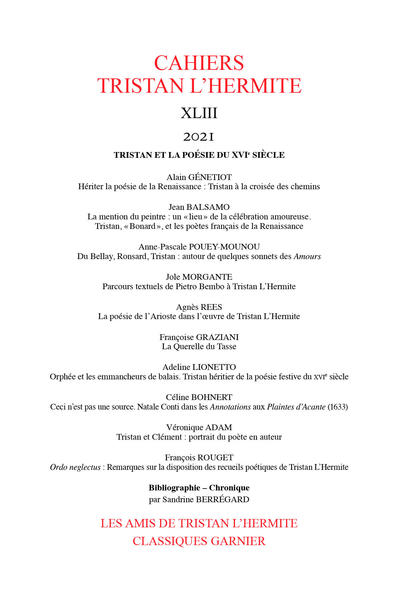
Cahiers Tristan L’Hermite, 2021, n° XLIII : Tristan et la poésie du XVIe siècle
Posted: 31 Jan 2022 - 04:26

Cahiers Tristan L’Hermite, 2021, n° XLIII : "Tristan et la poésie du XVIe siècle".
Revue des Amis de Tristan L’Hermite fondée en 1979, les Cahiers Tristan L’Hermite ont pour vocation d'éclairer l'œuvre du célèbre poète, dramaturge, romancier et prosateur en son temps (1601-1655) et plus largement la culture du premier XVIIe siècle.

Sommaire

Nombre de pages: 196
Parution: 17/11/2021
Revue: Cahiers Tristan L’Hermite, n° 43
ISBN: 978-2-406-12344-6
ISSN: 0241-9890
DOI: 10.48611/isbn.978-2-406-12345-3

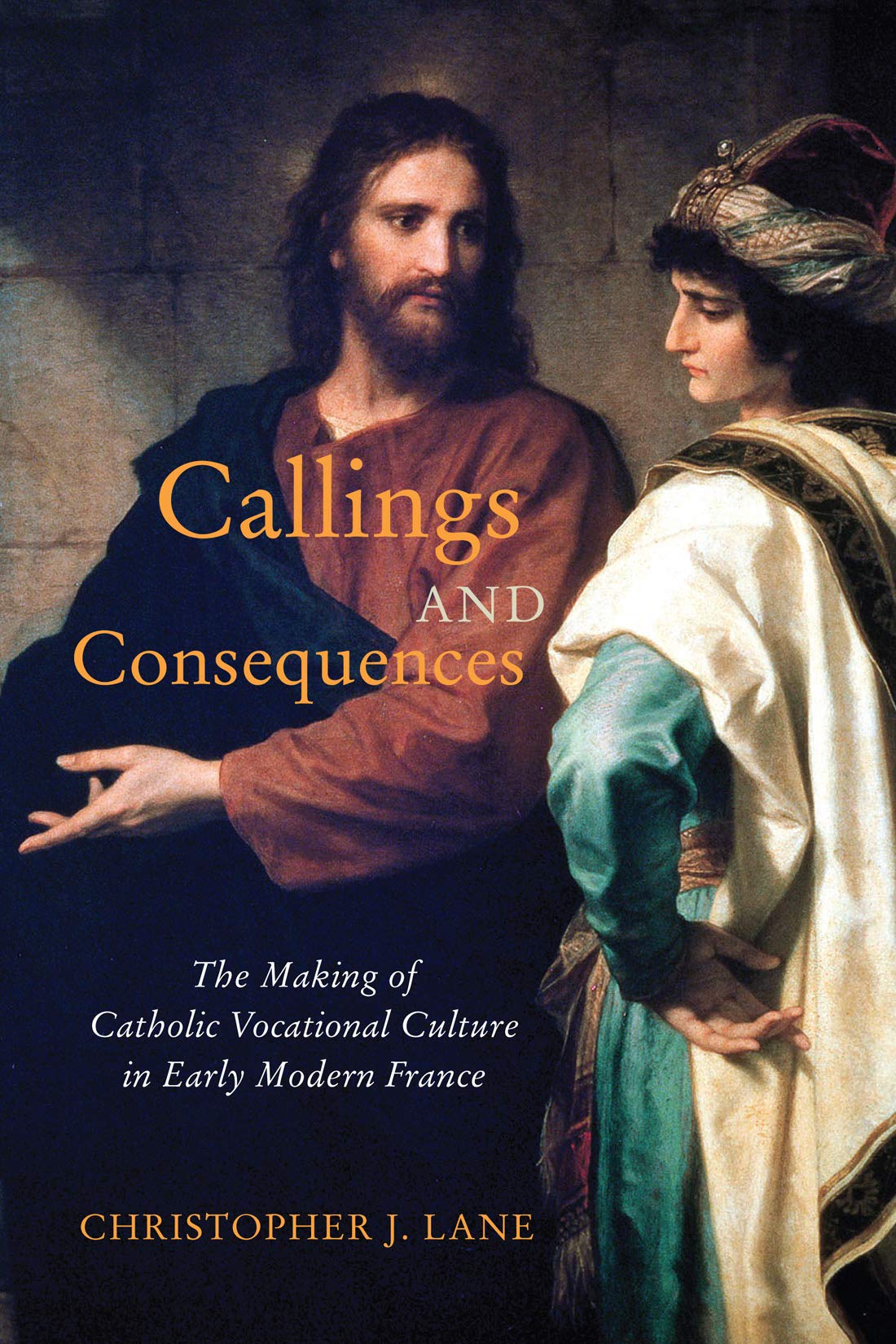
Christopher J. Lane, Callings and Consequences
Posted: 28 Jan 2022 - 15:50

Christopher J. Lane, Callings and Consequences: The Making of Catholic Vocational Culture in Early Modern France (Montreal and Kingston: McGill-Queen’s University Press, 2021). ISBN paperback: 978-0-2280-0855-2, $34.95; ISBN hardcover 978-0-2280-0854-5; ISBN PDF 978-0-2280-0975-7; ISBN ePub 978-0-2280-0976-4. See below for 20% discount.


The concept of vocation in an early modern Catholic setting calls to mind the priesthood or religious life; we sometimes assume that to be “called” by God meant to leave the lay state. Beginning in the mid-seventeenth century, French Catholic clergy began to promote the innovative idea that everyone, even an ordinary layperson, was called to a vocation or “state of life” and that discerning this call correctly had implications for one’s happiness and salvation, and for the social good.


Callings and Consequences analyzes the origins, growth, and influence of a culture of vocation that became a central component of the Catholic Reformation and its legacy in France. The reformers’ new vision of the choice of a state of life was marked by four characteristics: urgency (the assertion that one’s soul was at stake), inclusiveness (the belief that all Catholics, including lay people, were called to their state), method (the use of proven discernment practices), and liberty (the belief that this choice must be free from coercion, especially by parents). No mere passing phenomena, these vocational reforms engendered enduring beliefs and practices within the repertoire of global Catholic modernity, even to the present day.


An illuminating and sometimes surprising history of pastoral reform, Callings and Consequenceshelps us to understand the history of Catholic vocational culture and its role in the modernizing process, within Christianity and beyond.


Praise:

"It is hard to explain why the striking change in French discourse around vocation in the early modern era has gone almost unstudied, but from the point of view of the faithful, this was one of the biggest innovations of early modern Catholicism. Callings and Consequences provides a crucial introduction to the topic, filling a major gap in our understanding of the early modern Catholic world. All serious scholars of early modern Catholicism should read this book." Jotham Parsons, Duquesne University (author of The Church in the Republic: Gallicanism and Political Ideology in Renaissance France)


Table of Contents:

Introduction

1 – Before the Rigorist Turn: The Catholic Reformation of Vocation in the Long Sixteenth Century

2 – Urgency: Vocational Rigorism and the Dangers of Choosing Poorly

3 – Inclusiveness: Lay Vocation in a Rigorist Framework

4 – Method: Systematizing the Discernment Process

5 – Liberty: Parental Involvement without Parental Coercion

Conclusion

L'argent du libertinage (dir. E. Turcat)
Posted: 28 Jan 2022 - 15:30

Peut-on être libertin sans en avoir les moyens? De la noblesse décadente du Grand Siècle à la bourgeoisie parvenue des révolutions en passant par le demi-monde arriviste des Lumières, l'argent joue partout un rôle crucial, même lorsqu'il se métamorphose en une via crucis.
Site de l'éditeur

Table des matières

SOMMAIRE 
Le libertinage doré : la culture matérielle de l'inclination au XVIIe siècle 
KATHRYN A. HOFFMANN 
L’avare de Molière : richesse et ascension sociale face au libertinage 
ALICE BROWN 
L’argent du libertinage dans les Mémoires de Brienne le Jeune 

CLAIRE QUAGLIA

Finance, fraude, libertinage : mythe et histoire dans Le paysan parvenu et Manon Lescaut

JULIA LUISA ABRAMSON  
Manon des ressources ? Le roman de Prévost comme livre de raison 

ERIC TURCAT
Margot la ravaudeuse ou la réussite d’une fille du monde 

DENIS D. GRÉLÉ  

Zola ou le libertinage des Rougon sous le Second Empire 

ENCARNACIÓN MEDINA ARJONA  

Le thème de l’argent chez Léon Bloy. Un sujet socialiste ? 

GIOVANNI DOTOLI

Métamorphoses et mutations dans la littérature, les arts et l'histoire des idées (dir. P. Civil, R. Mondola, N. Peyrebonne et E. Sánchez García)
Posted: 28 Jan 2022 - 10:27

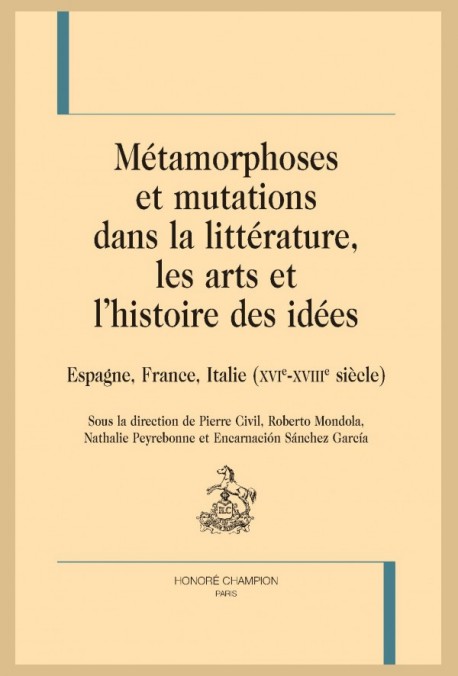
Métamorphoses et mutations dans la littérature, les arts et l'histoire des idées. Espagne, France, Italie (XVIe-XVIIIe siècle), dir. P. Civil, R. Mondola,  N. Peyrebonne  et E. Sánchez García, Paris, H. Champion, 2022.
La production littéraire et artistique des XVIe-XVIIe siècles a souligné une commune « fascination pour le transitoire et le protéiforme », à contre-courant de l’idéal d’harmonie et de permanence des formes, effets d’un monde en bouleversement, marqué par l’éphémère et l’indéterminé.

Dans l’espace culturel extrêmement relié que configuraient alors l’Espagne, l’Italie et la France, le concept de métamorphose, élargi à celui de mutation, s’est imposé en de multiples formulations.

Au-delà de la référence au texte fondateur des Métamorphoses d’Ovide et de son puissant imaginaire mythologique, sont abordées dans cet ouvrage les représentations littéraires et plastiques, érudites et « populaires », de la transformation de l’être humain en animal ou en élément naturel, et inversement.

Les œuvres phares de Dante, du Tasse, de Cervantès, de Rabelais… ainsi qu’une multiplicité de textes moins connus, dans les domaines de la prose de fiction, de la poésie et du théâtre, s’offrent à des études de cas de métamorphoses, prétextes à des réflexions implicites sur l’instabilité du monde, sur l’inachèvement et l’inaccompli, sur le temps et la mort.

D’un pays à l’autre, d’une forme à l’autre, d’une structure à l’autre, l’époque varie ainsi les perspectives à l’infini, en un jeu de miroirs parfois déformant, porteur à la fois d’illusions et de révélations.

Nathalie Peyrebonne et Pierre Civil sont spécialistes du Siècle d’Or espagnol et enseignent à l’Université Sorbonne Nouvelle.

Encarnación Sánchez García et Roberto Mondola sont professeurs de langue et culture de l’Espagne classique et contemporaine à l’Università degli Studi di Napoli L’Orientale.

Disponible en librairie et sur le site de l'éditeur.

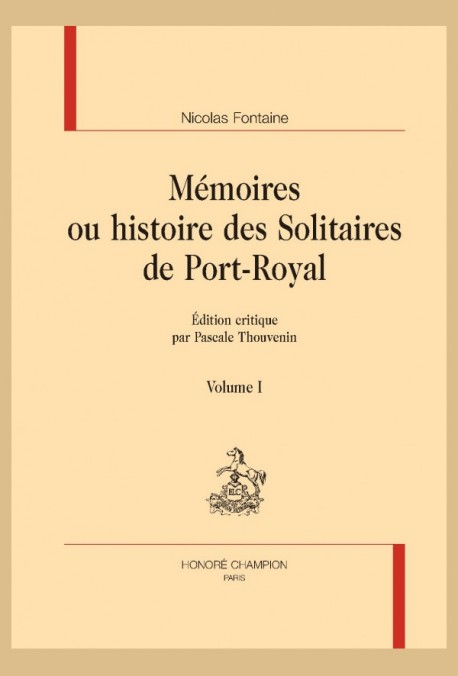
Nicolas Fontaine, Mémoires ou histoire des Solitaires de Port-Royal (éd. Pascale Thouvenin)
Posted: 28 Jan 2022 - 10:22

Nicolas Fontaine,  Mémoires ou histoire des Solitaires  de Port-Royal, éd. Pascale Thouvenin, Paris, H. Champion, 2022 (réimpression en version brochée de l'édition de 2001).

Voici pour la première fois le texte original des célèbres Mémoires de Nicolas Fontaine – le secrétaire de Lemaître de Sacy – où Sainte-Beuve voyait « de tous les ouvrages sur Port-Royal, celui qui nous en donne la plus vive et la plus parfaite idée… Nous entendons causer Pascal et Sacy, nous voyons d’Andilly se lever en souriant et venir à nous le long de ses espaliers en fleurs ».

Gravement mutilé par les éditeurs du XVIIIe siècle, ce « livre inimitable » retrouve enfin ses couleurs natives, grâce à la découverte par Pascale Thouvenin du manuscrit autographe, disparu depuis près de trois siècles. Le magnifique Entretien de M. Pascal avec M. de Sacy sur Epictète et Montaigne peut désormais être lu à la fois dans son intégralité et au sein du riche éventail d’entretiens qui nous font entendre Saint-Cyran, Singlin, Antoine Lemaître, la duchesse de Longueville ou Angélique Arnauld d’Andilly.

Témoin unique de la vie des Solitaires, Fontaine propose un parcours introspectif à l’imitation des Confessions de saint Augustin, un accomplissement de la littérature du moi, un monument du souvenir associant avec élan augustinisme et séduction.

Disponible en librairie et sur le site de l'éditeur.